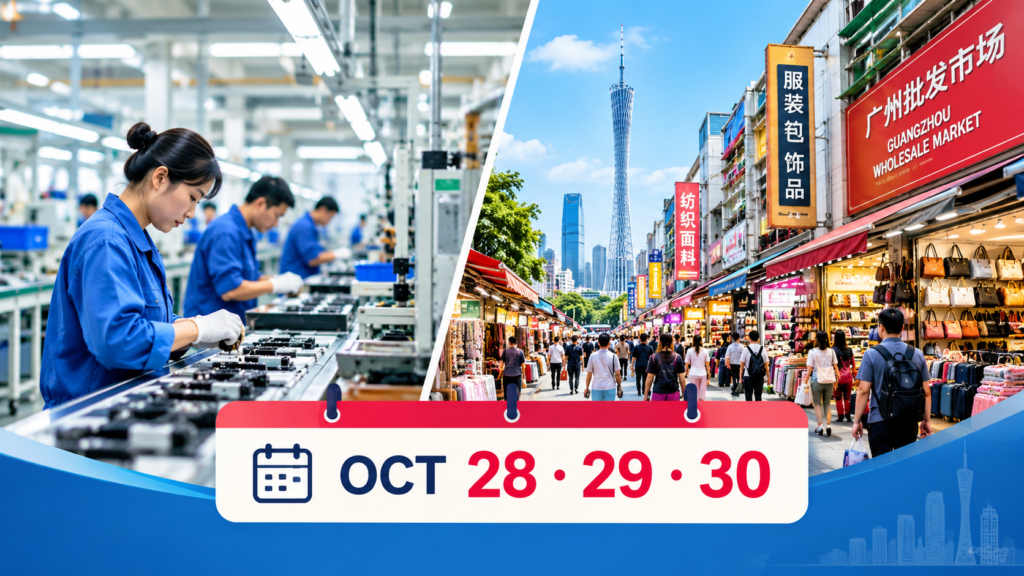
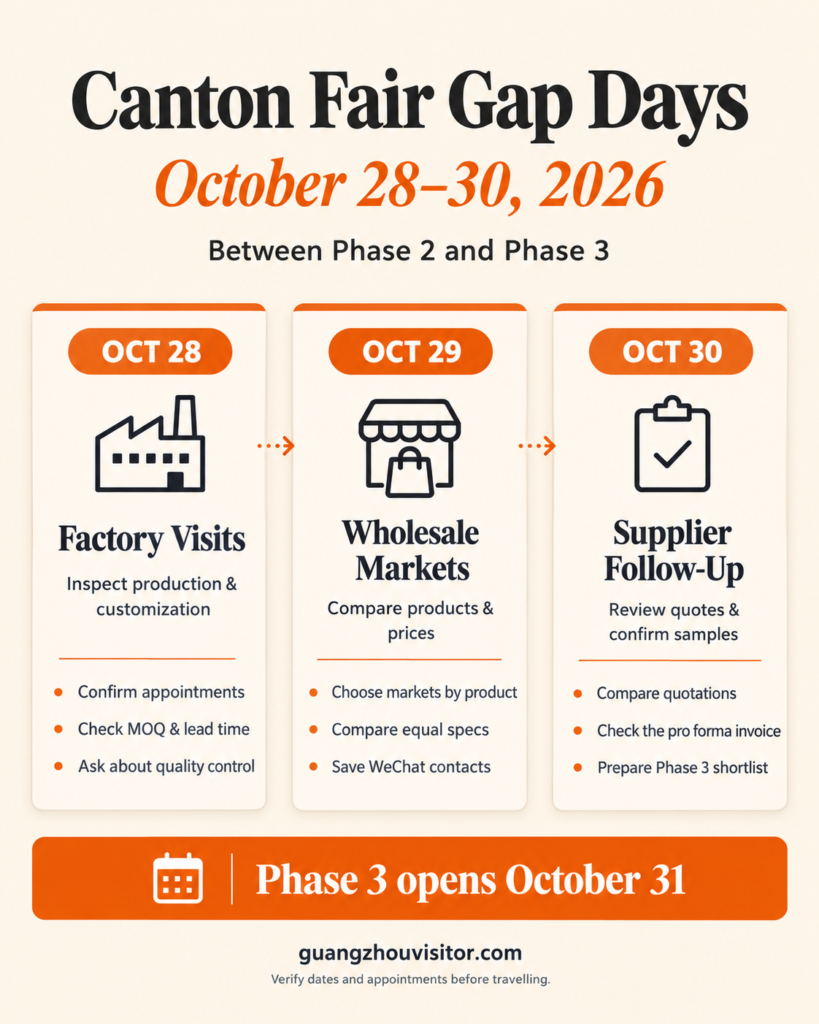
The gap between Canton Fair Phase 2 and Phase 3 is a valuable opportunity to do more than rest. From October 28 to 30, 2026, buyers can visit factories, explore wholesale markets in Guangzhou, compare supplier quotations, and follow up with exhibitors before the final phase begins.
Phase 2 runs from October 23 to 27, while Phase 3 runs from October 31 to November 4. That leaves three full days to focus on sourcing, product checks, and business decisions.
October 27, 2026
October 28–30, 2026
October 31, 2026
The key is to plan ahead. Factory visits require appointments, wholesale markets can be large and time-consuming, and travel outside Guangzhou needs careful coordination.
Related guide: Canton Fair 140 Survival Guide · Canton Fair 2026 Phases Explained
Official dates and exhibition information: Canton Fair Official Website.
Your Three-Day Plan at a Glance
| Date | Main Activity | Goal |
|---|---|---|
| October 28 | Factory visits | Inspect production capabilities and discuss customization |
| October 29 | Wholesale markets | Compare products, prices, and suppliers |
| October 30 | Supplier follow-up | Review quotations, confirm samples, and prepare for Phase 3 |
Adjust this schedule to your product category, supplier locations, and appointment availability.
Day 1: October 28 — Visit Factories and Meet Suppliers
A factory visit can help you assess a supplier beyond what you see in a Canton Fair booth or online catalogue.
Book appointments before travelling
Contact suppliers during Phase 2 or before the fair and ask whether a factory visit is possible on October 28. Confirm the address, meeting time, expected visit duration, and whether an interpreter is needed.
Potential destinations depend on your product category and supplier location. Tap a city to see the notes:
These are general sourcing suggestions, not guarantees that a particular supplier or factory will be available. Check the route and travel time before committing to an appointment. Avoid trying to visit several distant cities in one day.
Travelling to Foshan, Dongguan, or Shenzhen? Compare high-speed rail options and book in advance.
Book Rail TicketsAffiliate link — at no extra cost to you.What to check during a factory visit
Use this checklist to make the visit productive:
- Does the facility appear suitable for the product you want to order?
- What products are manufactured in-house, and what is outsourced?
- What is the minimum order quantity (MOQ)?
- Can the supplier customize materials, colours, packaging, or specifications?
- What are the production lead time and current capacity?
- What quality-control procedures are used?
- Can the supplier provide samples, certifications, or references relevant to your product?
Take notes and photographs only with permission. Do not rely on a factory tour alone as proof of quality or reliability; verify documentation and agree on inspection arrangements where appropriate.
Related guide: The Guangzhou Insider’s Import Bible
Useful Chinese phrases for factory visits
These Mandarin phrases can help when speaking with suppliers. The Pinyin includes tone marks to make pronunciation easier. Tap Copy Chinese to paste a phrase into WeChat or a translation app.
Need full messages instead of single phrases? Use the bilingual templates in our Canton Fair 140 Survival Guide.

A Full Day Beyond the City Center
Guangzhou Sunac Private Day Tour (From Guangzhou / Shenzhen)
Skip the crowds and public transport hassle with a private day tour to Guangzhou Sunac Land Resort in Huadu District — home to six theme parks inspired by Guangdong's local culture, from thrill rides and a flying theater to a snow world and water park. Ideal for families or travelers who want a full day of entertainment with door-to-door private transport from either Guangzhou or Shenzhen.
- Private, round-trip transport from your Guangzhou or Shenzhen hotel
- Access to multiple themed zones in one resort — rides, shows, and more
- Flexible pickup, ideal for families and small groups
Day 2: October 29 — Explore Guangzhou Wholesale Markets
If you do not have a factory appointment, use the second day to compare products and identify additional suppliers.
Guangzhou has wholesale districts specialising in different types of goods. Choose markets according to your sourcing needs rather than attempting to cover the entire city.
Markets and areas to consider
Market specialisations can change, and individual buildings or stalls may focus on different goods. Confirm the location, opening arrangements, and supplier availability before making the trip.
Related guide: Guangzhou Wholesale Markets Guide
How to compare suppliers efficiently
Do not choose a supplier based on the first attractive price. Compare several sellers using the same product specifications.
Record:
- Unit price and price breaks for larger orders
- MOQ and available colours or models
- Product materials and specifications
- Packaging options
- Sample price and availability
- Production lead time
- Export experience and shipping options
- Business contact details and follow-up arrangements
Ask whether the displayed price applies to the exact product and quantity you need. A low wholesale price may exclude packaging, customisation, taxes, or shipping.
Practical tip: Ask for a business card or the supplier's WeChat contact, and record the shop name and product details immediately. This will make it easier to identify the right supplier later.
Useful Chinese phrases for wholesale markets
Show the phrase on your phone or tap Copy Chinese to paste it into WeChat.
Day 3: October 30 — Compare Quotes and Prepare for Phase 3
Use the final gap day to organise your findings and follow up with the suppliers who best match your requirements.
1. Compare quotations
Put the most promising suppliers into one comparison sheet. Make sure you are comparing equivalent specifications and order quantities. You can fill in the table below; the lowest unit price is highlighted automatically, and your entries stay on this device.
| Item to Compare | Supplier A | Supplier B | Supplier C |
|---|
A slightly higher unit price may be worthwhile if the supplier offers better quality control, more suitable payment terms, or lower overall shipping costs.
2. Request written quotations and samples
Ask shortlisted suppliers for a written quotation covering the product specifications, quantity, unit price, MOQ, production lead time, packaging, payment terms, and quotation validity.
If you need samples, confirm their cost, dispatch date, and delivery method. Keep a record of which sample belongs to which supplier.
3. Review the pro forma invoice
Before paying a deposit, check the pro forma invoice (PI) carefully. It should identify the seller and buyer, product specifications, quantities, prices, payment terms, delivery terms, and expected production schedule.
Resolve any differences between the quotation and the PI before making payment. Verify the supplier's identity and payment details independently, especially if bank account information changes unexpectedly.
Related guide: Smart Import Hub — free import calculators
4. Check shipping and logistics
Discuss whether the supplier can arrange export shipping or whether you will use your own freight forwarder. Confirm the shipment's origin, destination, estimated timing, shipping method, and the applicable Incoterms.
For larger orders, ask about pre-shipment inspections and agree on the inspection criteria before production is completed. Independent inspection companies such as QIMA, SGS, and Bureau Veritas offer these services; check their current availability and fees for your product and location.
Do not assume that the supplier's quoted price includes freight, customs duties, or every other import cost.
Related guide: Shipping & Logistics
5. Prepare your Phase 3 priorities
Phase 3 begins on October 31. Before returning to the exhibition, review the exhibitors and product categories you want to visit.
Prepare a shortlist, organise your supplier contacts, and note the questions that remain unanswered. This helps you use your time at the fair to resolve specific issues instead of repeating conversations.
Related guide: Weekly Preparation Plan for Canton Fair 140
If You Cannot Visit a Factory
Factory visits are not essential for every buyer. If your suppliers are far away or appointments are unavailable, use the three days for remote meetings, sample reviews, quotation comparisons, and additional sourcing in Guangzhou.
You can also ask suppliers to arrange a live video tour, provide production photographs, or share relevant quality and compliance documents. Treat these as preliminary checks rather than substitutes for independent verification when the order value or risk warrants it.

Unlock the history behind the city. Book guided day tours, historic site visits, and stunning traditional performances highly recommended by fellow travelers.
Book ExperienceAffiliate link — at no extra cost to you.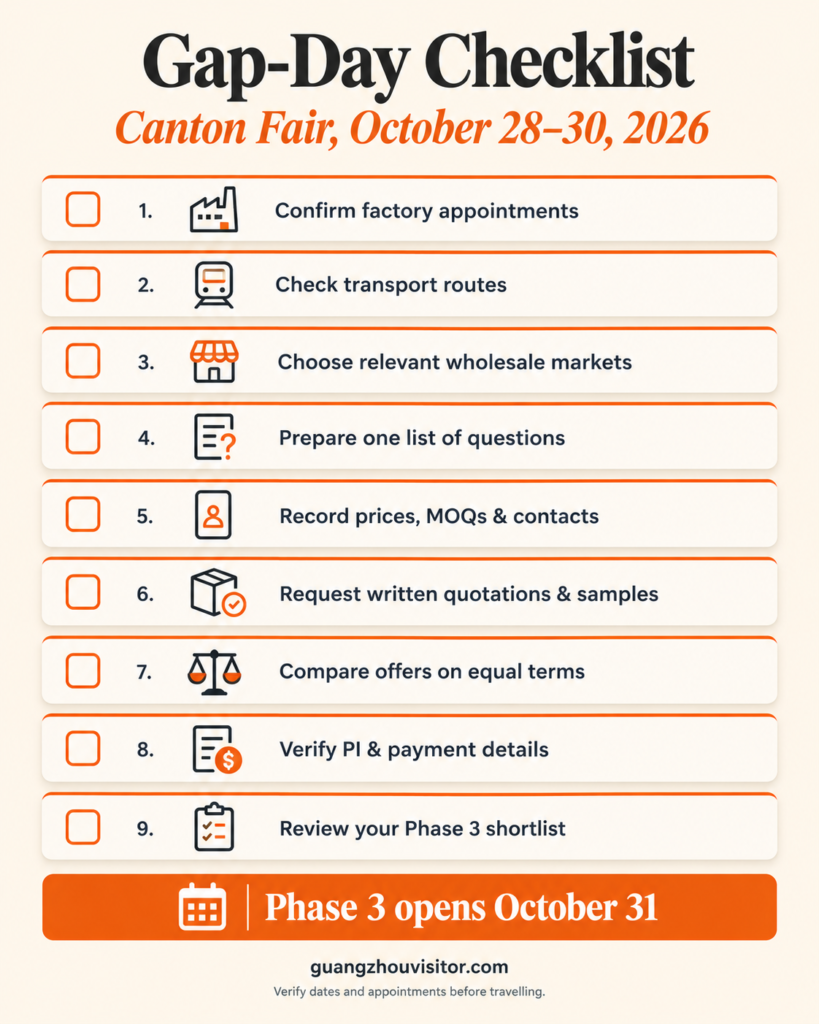
Frequently Asked Questions
When are the Canton Fair gap days in 2026?
The three days between Phase 2 and Phase 3 are October 28, 29, and 30, 2026. Phase 2 ends on October 27, and Phase 3 begins on October 31.
Are factories open during the gap days?
Some factories may operate normally, but availability varies by company, location, and appointment schedule. Contact the supplier in advance and obtain confirmation before travelling.
Can I visit a factory and a wholesale market on the same day?
It may be possible if both locations are close enough and the factory appointment is short. However, travelling between cities can consume a significant part of the day. For most buyers, one main activity per day is easier to manage.
Should I place an order during the gap days?
Use the time to verify specifications, compare quotations, and clarify terms. Place an order only when you are comfortable with the supplier, product details, payment arrangements, and agreed terms.
Do I need to speak Chinese?
Not necessarily, but basic Mandarin phrases and Pinyin can help with simple questions. A translation app or interpreter may be useful for detailed negotiations, technical specifications, and contract discussions.
Final Advice
The Canton Fair gap days are most valuable when you use them to make better sourcing decisions. Visit factories when appointments are confirmed, explore only the wholesale markets relevant to your products, and reserve October 30 for supplier follow-up and preparation.
By the time Phase 3 opens on October 31, you should have clearer quotations, better supplier records, and a more focused list of business priorities.
Related reading
- Canton Fair 140 Survival Guide
- How to Prepare for the Canton Fair
- Guangzhou Wholesale Markets: A Practical Guide
Sources
- Canton Fair Official Website — phase dates and exhibition information.
- ICC — Incoterms® 2020 rules.
Dates, market specialisations, transport and factory availability can change. Verify important details through official sources and directly with each supplier before travelling or paying.
🏭 Related Canton Fair & Sourcing Guides
🇨🇳 Related China Travel Guides
Before you land