
Canton Fair Guide
For International Buyers & Importers
Phases, visas, negotiation tactics, and the 48-hour follow-up plan — everything you need to source with confidence at China's largest trade fair.
Every year, more than 310,000 overseas buyers fly into Guangzhou for one reason: to walk the halls of the Canton Fair and find suppliers they can trust for the next five, ten, or twenty years. If you are reading this, you are probably one of them — an Amazon seller scaling past your first few SKUs, a small business owner ready to cut out a middleman, or a first-time visitor who has heard the stories and wants to arrive prepared instead of overwhelmed. This guide exists to replace guesswork with a plan. It covers exactly when to go, what to bring, how to negotiate like someone who has done this before, and — just as importantly — what to do in the 48 hours after the fair ends, when most first-time buyers actually lose the deal they thought they had won.
What Is the Canton Fair?
"Guangzhou fair" usually refers to the Canton Fair, officially the China Import and Export Fair. It is China's oldest and largest comprehensive trade fair, running since 1957 and held twice a year in Guangzhou — once in spring and once in autumn. For most international buyers researching how to import from Guangzhou for the first time, the Canton Fair is the single most efficient entry point: instead of visiting dozens of factories across the Pearl River Delta, you meet thousands of verified exporters under one roof, across three sequential phases.
For Amazon FBA sellers specifically, the calculus is a little different from a traditional wholesale importer: you're usually optimizing for a narrower product range, tighter quality tolerances tied to review scores, and packaging that needs to survive Amazon's own inbound requirements. That makes the pre-fair homework in the sections below — target price, sourcing list, and phase selection — even more important, since a single mismatched supplier can cost you weeks of FBA prep-center delays later.
- Focus: Primarily export trade, with import booths and business services (consulting, logistics, etc.)
- Scale: 1.55 million square metres of exhibition space at the Canton Fair Complex in Pazhou.
- Exhibitors: Over 32,000 companies participate each session.
- Buyers: More than 310,000 overseas buyers from 223 countries and regions.
According to official reports from China Daily, the fair remains the premier destination for global sourcing, offering an unmatched variety of suppliers. What that scale means in practice is simple: no single buyer can "do" the whole Canton Fair. The buyers who leave with signed orders are the ones who treat it like a targeted sourcing mission, not a sightseeing trip — which is exactly what the rest of this guide is built around.
Unlike a niche industry trade show abroad, the Canton Fair was built as a national platform: it was launched in 1957 to open trade channels for Chinese manufacturing at a time when few alternatives existed, and it has grown alongside China's export economy ever since. That history matters for buyers today because it explains why the fair still operates at government level rather than as a private trade show — exhibitor vetting, hall allocation, and dispute channels all sit under an official mandate, which is part of why serious international buyers still prioritize it over regional expos.
For sourcing strategy, this also means the fair works best as the first step in a longer relationship, not a one-time transaction. Many of the suppliers you meet in Guangzhou will also exhibit at the next session, and the buyers who return twice a year to the same hall, checking in with the same booths, are consistently the ones who report the most reliable production runs and the fewest quality surprises.
When It Takes Place – Autumn 2026 (140th Session)
The fair is held in three phases, each dedicated to a different set of product categories. Dates shift slightly every year, so always cross-check the official schedule before booking flights. For the upcoming 140th session, the confirmed Autumn 2026 dates are:
| Phase | Dates | Main Product Categories |
|---|---|---|
| Phase 1 | October 15–19, 2026 | Household appliances, consumer electronics, information products, industrial automation, machinery, power equipment, new energy vehicles, smart mobility, hardware, tools. |
| Phase 2 | October 23–27, 2026 | Ceramics, kitchenware, housewares, glass crafts, home decorations, garden products, gifts & premiums, clocks & glasses, furniture, building materials. |
| Phase 3 | October 31 – November 4, 2026 | Toys, baby & maternity products, clothing, home textiles, carpets, office supplies, medical & health products, food, personal care, pet products. |
Expert Tip: Don't try to attend all phases unless your business genuinely spans multiple industries. Most professional buyers focus on one specific phase to maximize their time and energy. Quality over quantity is the key to a successful sourcing trip — three focused days beat nine exhausted ones.
If your product range straddles two phases — for example, home textiles (Phase 3) and home decor (Phase 2) — it is usually more efficient to attend the tail end of one phase and the opening days of the next, rather than committing to a full nine-day marathon. Build in at least one rest day between phases; your feet, and your note-taking accuracy, will thank you.
This Canton Fair 2026 timing is the single most important planning input for anyone building a broader Canton Fair survival guide of their own: everything else in this article — visas, hotels, negotiation strategy, and the post-fair follow-up plan — is built around whichever phase actually matches what you plan to import from Guangzhou. Confirm your phase first, then work backward from those dates when booking flights and accommodation.
Official Organizers
The Canton Fair is organized under the highest level of government authority to ensure international standards:
- Ministry of Commerce of the People's Republic of China.
- People's Government of Guangdong Province.
- China Foreign Trade Centre (executive organizer).
Venue & Location
- Address: Canton Fair Complex (Pazhou), 382 Yuejiang Zhong Road, Haizhu District, Guangzhou.
- Metro: Pazhou Station (Line 8) connects directly to the complex.
Guangzhou itself is worth understanding beyond the fairgrounds: it is the capital of Guangdong Province and the historic heart of the Pearl River Delta manufacturing region, which means the Canton Fair sits at the center of a much larger ecosystem of factories, wholesale markets, and logistics providers. Many buyers use their trip to combine a few days at the fair with a short factory visit or a walk through nearby wholesale markets — something worth planning into your itinerary if your sourcing volume justifies the extra time on the ground.

Exhibition Hall Floor Plan
The complex is divided into Area A, B, C, and D, spread across a site so large that first-time visitors routinely underestimate the walking distance between halls. Each area is effectively its own trade show — treat moving between them as a deliberate decision, not a quick detour.
Phase 1: Area A & B
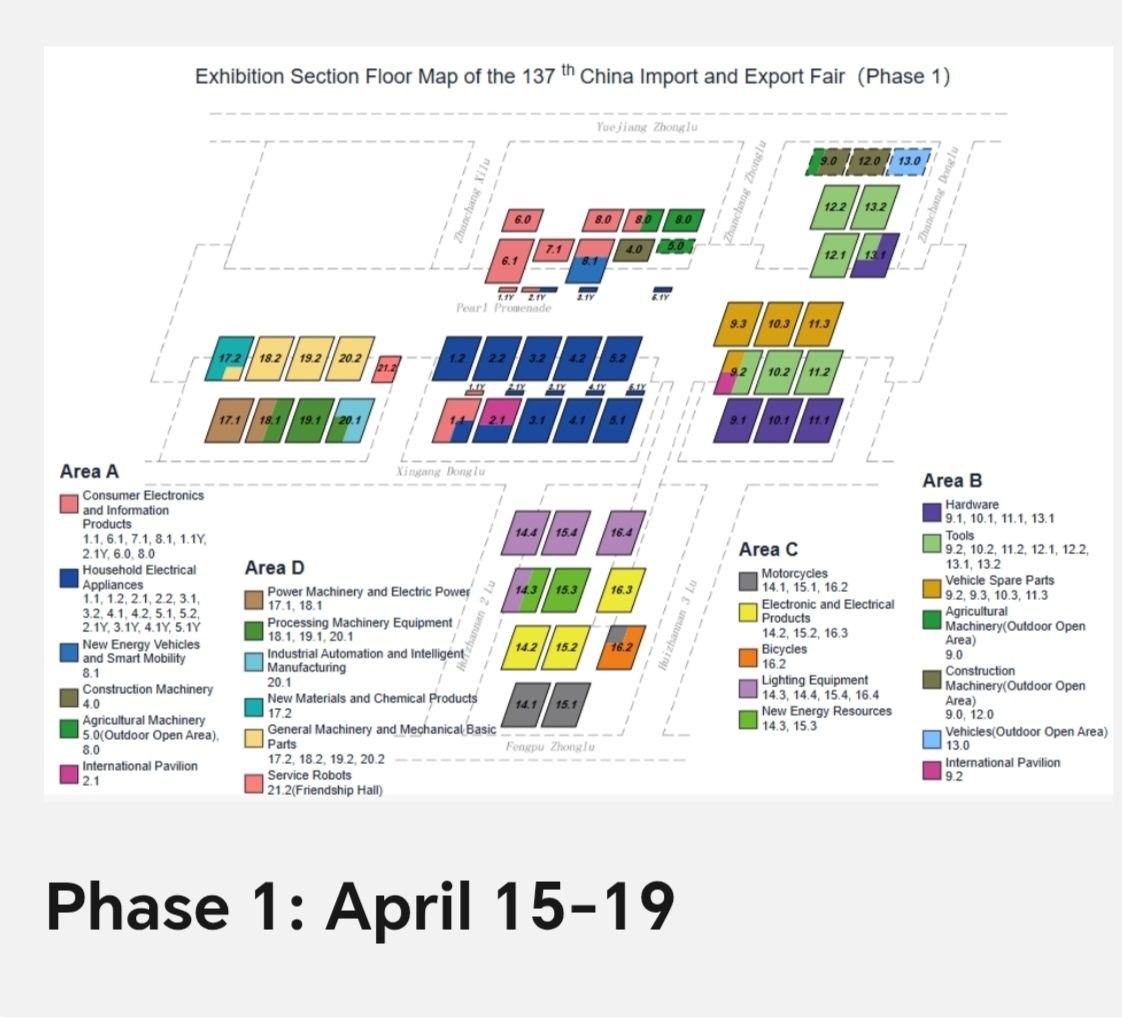
Area A & B: The heart of industrial and electronic sourcing.
Phase 2: Area C
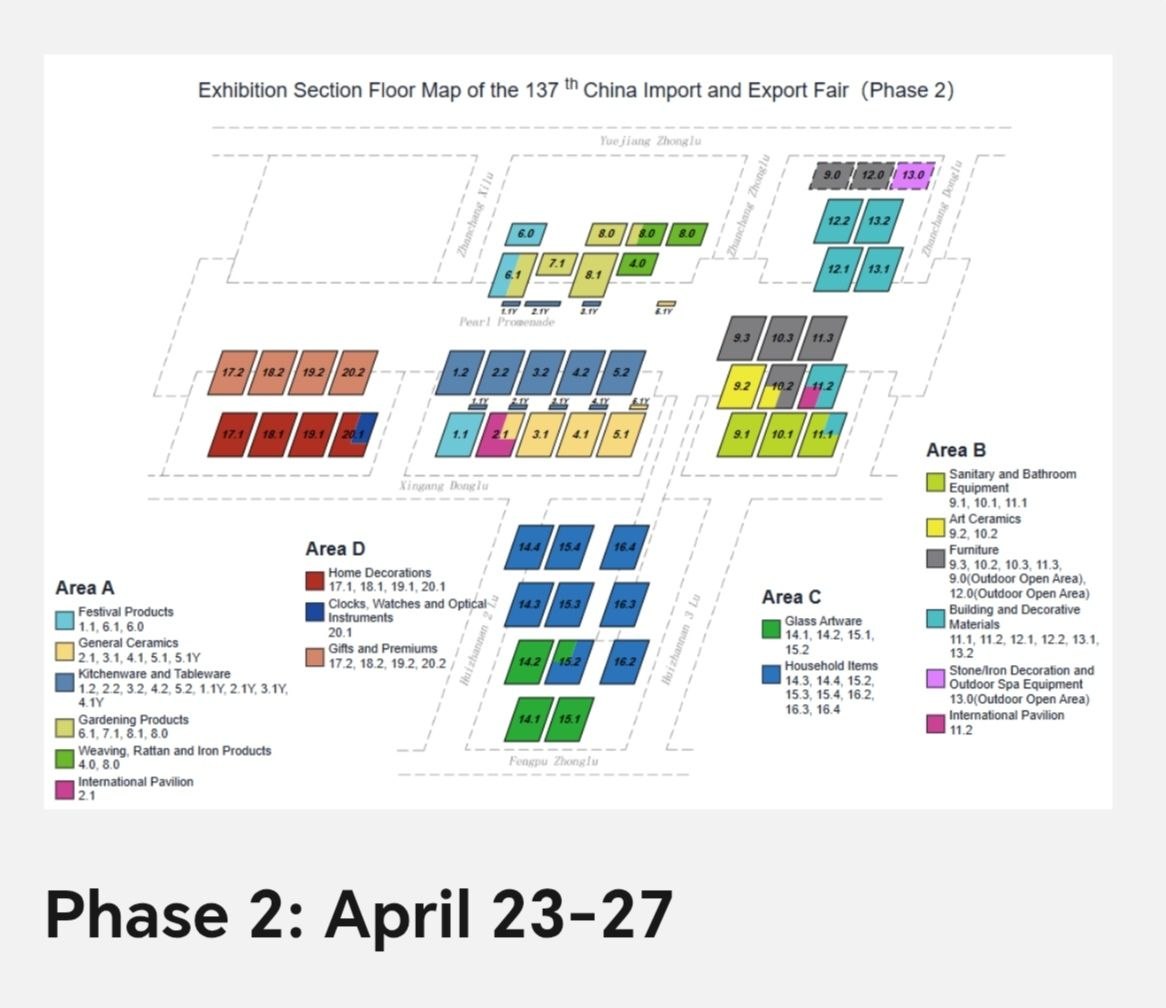
Area C: Consumer goods, gifts, and home décor hub.
Phase 3: Area D
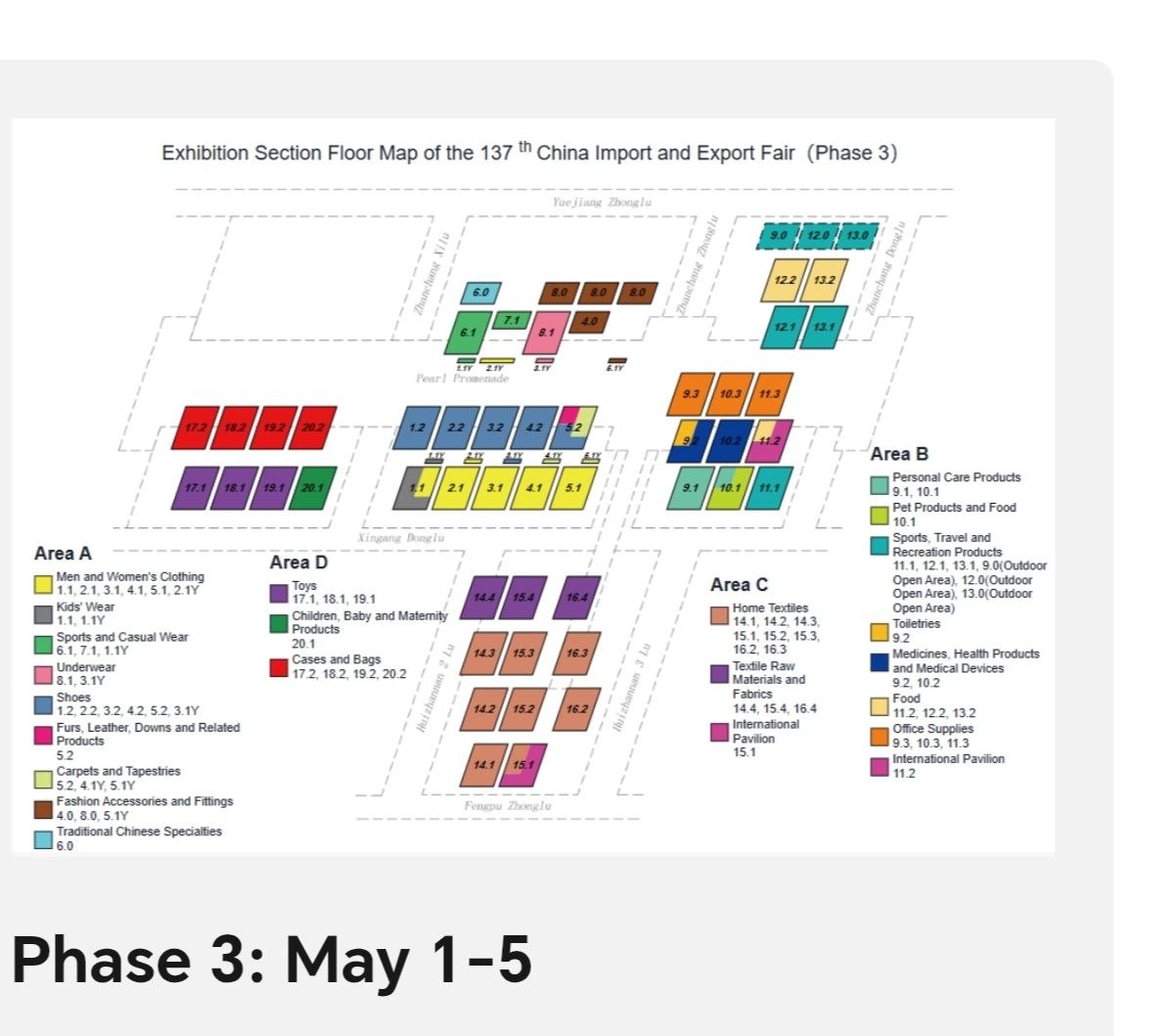
Area D: New expansion focusing on textiles and health.
📍 Navigation Mastery: Save the official floor plan on your phone. Area A is best accessed via Xingangdong Station (Exit A), while Areas B, C, and D are closer to Pazhou Station.
Inside each area, halls are numbered sequentially and connected by long indoor concourses with escalators, charging points, and rest areas roughly every two to three halls. If your sourcing list spans several floors within the same area, work top-down or bottom-up rather than zig-zagging — it sounds obvious, but it is the single biggest time-saver on-site.
Booth numbers follow a hall.row.stand format — for example, "12.3 D25" means Hall 12, row 3, stand D25. Once you understand this pattern, cross-referencing the exhibitor directory against the printed floor plan becomes fast rather than confusing. Photograph the hall directory boards near each entrance; they're far easier to zoom into later than trying to memorize a row number while walking.
Before You Go: Registration, Visa & Documents
Getting the paperwork right is what separates a smooth first day from two hours in a registration queue.
Pre-Registration
- Check which phase matches your products using the schedule above.
- Pre-register online as a buyer — it's free. Upload your passport and company details.
- Apply for an invitation letter if you need a business visa.
- Receive your QR code to collect your buyer badge on-site or at select hotels.
Visa & Entry Requirements
Most nationalities require a business visa (M visa). Request an invitation letter from the organizers during your online registration — it is issued automatically once your buyer profile is approved.
2026 Visa-Free Update: Passport holders from the UK, Canada, Australia, and most EU member states currently qualify for 30-day visa-free entry to mainland China under China's expanded unilateral visa-free policy. This covers short business trips like the Canton Fair, but rules are updated periodically — always verify your specific eligibility on the official Chinese embassy website for your country before booking flights.
Badge, Visa & Documents Checklist
Bring with you: passport, at least 200 business cards, a company profile, a clear sourcing list (products, target prices, MOQs), and digital copies of every document saved on your phone and emailed to yourself as a backup.
One detail first-timers often miss: your buyer badge is tied to the passport used at registration, and it typically must be collected in person with that same passport on your first visit. If you are traveling with colleagues, each person needs their own registration and their own badge — a single company registration does not cover a group. Give yourself at least an extra 30 minutes on day one purely for badge collection, even with pre-registration completed, since queues still form at the collection counters during peak morning hours.
Getting There & Where to Stay
Where to Stay? I recommend staying in the Tianhe District or near Pazhou. If you stay in Tianhe, you are close to the best food and shopping after the fair ends. Use Booking.com to find hotels with complimentary shuttles.
| Transport Method | Cost (Approx) | Time from Airport | Best For... |
|---|---|---|---|
| Metro (Line 3 → 8) | 8–10 RMB | 60–70 mins | Budget travelers |
| Taxi / Didi | 120–160 RMB | 45–60 mins | Comfort & Groups |
| Shuttle Bus | 25–30 RMB | ~50 mins | Direct drop-off at major hotels |
For seamless travel arrangements, we recommend booking your flights and trains via Trip.com for the best rates and reliability.

More Hotel Options by Budget
| Budget Tier | Area | What to Expect |
|---|---|---|
| Budget | Pazhou / Xingangdong | Compact business hotels within 10–15 minutes' walk of the complex; ideal if you want to nap between hall visits. |
| Mid-Range | Tianhe / Zhujiang New Town | International chain hotels with reliable Wi-Fi, English-speaking staff, and easy metro access to the fairgrounds. |
| Luxury | Zhujiang New Town / Pearl River waterfront | Five-star towers with executive lounges — popular with buyers hosting supplier dinners or closing large orders on-site. |
Pro Tip: Do NOT take a taxi during peak hours (17:30 – 19:00). The traffic around Pazhou is legendary. The Guangzhou Metro is your best friend during fair days — it's fast, clean, and reliable.
If this is your first trip, the trade-off is straightforward: Pazhou saves you roughly 30–40 minutes of commuting each way, which adds up to hours over a multi-day phase, while Tianhe gives you a wider choice of restaurants, malls, and evening entertainment once the halls close at 18:00. Buyers attending a single phase on a tight schedule usually do better in Pazhou; buyers combining sourcing with client dinners or a few days of leisure tend to prefer Tianhe.

Daily Schedule & On-Site Navigation
- Opening hours: 09:30 – 18:00. Arrive early for security checks.
- Use the official Canton Fair app to search for suppliers and hall maps.
- Wear extremely comfortable shoes: you will walk many kilometres each day.
How to Plan Your Visit (For Buyers)
Focus on sample quality, MOQs, lead times, and certifications. Take systematic notes: hall number, booth number, and photos to match business cards later. Don't be afraid to ask for a sample, but respect the exhibitor's policy. Search the online exhibitor directory before you arrive, note down the booth numbers on your priority list, and always take a short lunch break — buyers who skip lunch make worse decisions by 3pm.
A realistic pace is 15–25 booths per day if you actually stop to talk, ask questions, and take notes rather than just collecting flyers. Group your priority booths by hall before you start walking, so you're not crossing back and forth across the same area three times in one afternoon. Many experienced buyers split each day into two blocks — a morning block for their top-priority suppliers, when both you and the exhibitor staff are freshest, and an afternoon block for secondary options and follow-up visits to booths you want to revisit before making a decision.
Money, Connectivity & Practical Tips
⚠️ Critical Tech Prep: Most Google services are blocked. You MUST install Alipay, WeChat, and Amap (Gaode Maps) BEFORE you land in China, as downloading them locally can be difficult.
Essential Apps to Install Before You Land
| App | Purpose |
|---|---|
| Communication with suppliers — most factories prefer it over email. | |
| Alipay | Payments, transport top-ups, and increasingly, sample purchases at the fair. |
| Amap (Gaode Maps) | Navigation — the reliable Google Maps alternative in mainland China. |
| DiDi | Ride-hailing when the metro isn't practical, especially with samples in tow. |
| Pleco | Offline Chinese-English dictionary — invaluable for reading product spec sheets. |
| China eSIM (via Klook/Airalo) | Instant mobile data on arrival without hunting for a local SIM card. |
Money & Payments
Digital payments dominate day-to-day spending: Alipay and WeChat Pay are accepted almost everywhere, from taxis to street food. Still, carry 500–1,000 RMB in cash for the rare vendor or small stall that doesn't take digital payment, and keep in mind that international credit cards are rarely accepted directly at exhibitor booths — sample payments and deposits are usually settled via bank transfer, Alipay, or occasionally PayPal for established suppliers.
Local Business Etiquette
Present business cards with both hands. Don't be surprised by direct questions about prices. A simple "Nǐ hǎo" (Hello) is always appreciated and builds immediate rapport.

Tipping & Other Local Customs
Tipping is not customary in mainland China, including at restaurants, in taxis, or with suppliers — it can even come across as awkward rather than generous, so there's no need to budget for it. Do, however, factor in small courtesy gestures with suppliers: accepting a cup of tea when offered, or exchanging a modest business gift on a return visit, is far more culturally meaningful here than a cash tip would be.
🤝 Master Negotiation at the Canton Fair
Negotiation at the Canton Fair is different from negotiating in a factory showroom. You have less time per booth, more competing buyers in the room, and vendors who are pattern-matching you within the first thirty seconds. Here's how to get the best deals without wasting either side's time.
Chinese business culture places real weight on guanxi — relationship and mutual trust — even inside a fast-moving trade fair setting. That doesn't mean every negotiation needs to be a lengthy relationship-building exercise; it means that patience, respect, and a calm tone consistently outperform aggressive haggling. Exhibitors staff their booths for nine or ten straight days across a session, meeting hundreds of buyers, and the ones who stand out in their memory afterward are rarely the loudest — they're the ones who asked sharp questions and treated the conversation as the start of a working relationship, not a one-off haggle.
Before You Negotiate
| Step | Details |
|---|---|
| 1. Do Your Homework | Research average prices for your product before you arrive. Know what competitors charge. |
| 2. Set a Target Price | Know your maximum price before you start talking, and don't reveal it first. |
| 3. Prepare Questions | Ask about MOQ, lead time, payment terms, and certifications before price even comes up. |
During Negotiation
| Tactic | How to Apply |
|---|---|
| Start Low, But Reasonable | Offer 30–40% below their first quote. This gives room to negotiate up without insulting them. |
| Ask About MOQ Flexibility | "Can I order 50 pieces instead of 200?" — many vendors will adjust for serious buyers. |
| Request Samples | "Can I take a sample today?" — most will sell samples at 1–2x the bulk price. |
| Get It in Writing | Ask for a written quote with all terms (price, MOQ, delivery, payment). |
| Build Rapport | A smile and a friendly attitude go a long way. Learn a few Chinese phrases. |
Red Flags to Watch For
| Red Flag | Warning |
|---|---|
| Price Drops Too Fast | If they drop 50% immediately, the original price was inflated. Be careful. |
| No Samples Available | If they won't give you a sample, question their product quality or production capacity. |
| Vague Delivery Dates | "Maybe 30 days" is not a commitment. Get a specific date in writing. |
| No Written Quote | Always get a written quote before leaving the booth — memory fades after 40 booths. |
"The best deals happen on the last day of each phase. Vendors don't want to pack samples and ship them back. They'll sell at cost or below."
"Bring a notebook. Write down booth numbers, contact names, and prices. You'll visit 50+ booths — you won't remember everything."
❌ 5 Common Mistakes First-Time Canton Fair Visitors Make
Even experienced buyers make mistakes. Here are the most common ones — and how to avoid them. None of these are exotic errors; they're small planning gaps that compound over a nine-hour day on your feet, and every one of them is fully preventable with the checklist further down this page.
Mistake #1: Attending the Wrong Phase
| Problem | Solution |
|---|---|
| You book your trip for Phase 1 (electronics) but your products are in Phase 3 (textiles). | Check the phase dates before booking your flight. Save the phase table on your phone. |
Mistake #2: Not Pre-Registering Online
| Problem | Solution |
|---|---|
| You arrive at the fairgrounds and wait 2+ hours in line to register on-site. | Pre-register online before you travel. It's free and saves hours of queueing. |
Mistake #3: Forgetting Business Cards
| Problem | Solution |
|---|---|
| You meet a great supplier but have no business card to give them. | Bring at least 200 business cards. Chinese suppliers expect them. |
Mistake #4: Not Taking Notes
| Problem | Solution |
|---|---|
| You visit 40 booths in one day. By evening, you can't remember which supplier offered what. | Take notes at every booth — booth number, contact name, price, MOQ. Take photos of products and business cards. |
Mistake #5: Not Following Up After the Fair
| Problem | Solution |
|---|---|
| You collect 100 business cards but never contact anyone. | Follow up within 48 hours. Send a WeChat message or email referencing your meeting at the fair. |
✅ Canton Fair Buyer Checklist
Print this checklist and check off each item before you go, or use the interactive version below — your progress is saved automatically in this browser, so you can close the tab and pick up exactly where you left off. It's split into the three moments that matter most: before departure, on-site, and the critical first 48 hours after the fair closes.
🛫 Before You Go (2–4 Weeks Before)
🏛️ At the Fair (During Your Visit)
📬 After the Fair (Within 48 Hours)
📦 After the Fair: Turning Contacts into Orders
The Canton Fair is where you meet suppliers. The real work — and where most first-time buyers lose momentum — begins after you return home. Jet lag, a backlog of emails, and the sheer volume of business cards you collected all conspire to push follow-up down your priority list. Suppliers notice this too: the ones who respond fast and specifically are the ones who get remembered, restocked with samples first, and quoted more competitive pricing on the next order.
Step 1: Organize Your Notes
| Action | Details |
|---|---|
| Create a spreadsheet | Columns: supplier name, contact, product, price, MOQ, lead time, notes. |
| Categorise | Group suppliers by product category so comparisons are apples-to-apples. |
| Rate each supplier | Score them on communication, price, quality, and professionalism. |
Step 2: Follow Up Within 48 Hours
| Action | Details |
|---|---|
| Send a WeChat message | Chinese suppliers prefer WeChat over email for speed. |
| Reference your meeting | "We met at Booth 12.3 on [date]" — jog their memory instantly. |
| Ask for a formal quote | Request a written quote with all terms, not a verbal recap. |
| Request samples | Order samples from 2–3 top suppliers before committing further. |
Step 3: Order Samples
| Action | Details |
|---|---|
| Order samples before bulk | Test quality, packaging, and real-world shipping time. |
| Compare samples | Put samples side by side to compare quality objectively. |
| Test functionality | If electronics, test every feature before approving mass production. |
Step 4: Quality Control
| Action | Details |
|---|---|
| Hire a QC inspector | Third-party inspection companies (like SGS or Bureau Veritas) catch issues before shipping. |
| Ask for photos/videos | Request production progress photos throughout the run. |
| Test before shipping | If possible, visit the factory or hire a local agent for a final check. |
Step 5: Finalize Shipping
| Action | Details |
|---|---|
| Compare shipping options | Sea (30–45 days), Air (5–10 days), Express (3–5 days). |
| Get a written shipping quote | Include all fees: dock fees, customs, insurance. |
| Choose incoterms | FOB, CIF, or DDP — know exactly what each one makes you responsible for. |
Frequently Asked Questions
Do I need a visa?
Most nationalities require a business visa (M visa). Request an invitation letter from the organizers during registration. Note that UK, Canadian, Australian, and most EU passport holders currently qualify for 30-day visa-free entry — verify current eligibility before booking.
Can I buy single samples?
Yes, most exhibitors sell single samples, though prices are often higher. It's best to ask on the final day of each phase.
Do I need a translator?
Most booths have English-speaking staff. However, for complex technical negotiations, hiring a professional interpreter for the day is highly recommended to avoid costly misunderstandings.
How do I register for free?
Online pre-registration is free. If you register on-site at the fairgrounds, there is typically a fee of 100–200 RMB.
Can I attend the Canton Fair without pre-registration?
Yes, but you'll pay 100–200 RMB and wait in long queues, sometimes over two hours during peak morning hours. Pre-registration is free, takes about ten minutes online, and is highly recommended.
Do I need to speak Chinese?
No. Most exhibitors at the Canton Fair have English-speaking staff. For technical negotiations, consider hiring a professional interpreter.
How many samples can I carry?
You can carry as many as you can physically manage. Most buyers bring a rolling suitcase or bag on wheels.
What's the dress code?
Smart casual. Comfortable shoes are essential. Wear something that looks professional but allows you to walk for hours.
Can I pay in USD?
Some exhibitors accept USD, but most prefer RMB. Have a mix of both. WeChat Pay and Alipay are widely accepted.
How do I find suppliers in advance?
The Canton Fair has an online exhibitor directory searchable by product category, company name, and hall. Search for your product, note the booth numbers, and build your day-by-day route before you arrive — this alone can save several hours of on-site wandering.
What are the best days to visit?
Days 1–3 are busiest but have the widest selection. Days 4–5 are quieter, and vendors may be more willing to negotiate.
How do I avoid long queues?
Pre-register online, arrive early (before 09:00), and use less busy side entrances.
Can I bring a bag to the fair?
Yes, but it may be subject to security checks. Most buyers bring rolling suitcases or light backpacks.
What should I do if I lose my passport?
Contact your country's embassy or consulate in Guangzhou immediately — most issue emergency travel documents within a few business days. Keep a digital copy of your passport photo page on your phone, in your email, and ideally with a travel companion, since it significantly speeds up the replacement process.
Recommended Official Resources for Verification:
Final Thoughts: Making the Canton Fair Work for Your Business
The Canton Fair rewards preparation more than almost any other trade event in the world. Buyers who arrive with a defined phase, a sourcing list, a target price, and a plan for the 48 hours after the halls close consistently outperform buyers who show up hoping to "see what's there." Everything in this guide — the visa timeline, the phase table, the negotiation tactics, the follow-up steps — exists to move you from the second group into the first.
If this is your first Canton Fair, resist the urge to over-plan every minute. Build a realistic shortlist, protect your energy for the booths that actually matter, and treat the fair as the opening move in a longer sourcing relationship rather than a single transaction. The suppliers worth working with for years are usually easy to spot: they answer questions directly, they don't dodge a written quote, and they're still just as responsive in week three of your email follow-up as they were on the show floor.
📥 Get Your Free Sourcing Guides
Before you fly out, grab both of our free downloadable guides — built specifically for buyers navigating the Canton Fair and Guangzhou's wholesale ecosystem for the first time.
Guangzhou Sourcing Guide
The essential checklist for every buyer visiting the Canton Fair.
Download via Payhip Download via GumroadGuangzhou Mini-Guide
Quick reference for navigation, food, and local business etiquette.
Download via Payhip Download via GumroadContinue your sourcing research: explore our Wholesale Markets Guide, compare shipping options in our Shipping & Logistics guide, get set up with our Travel Essentials (apps, eSIM, insurance), download our Business Checklist, refuel between booths with our Food & Drinks guides, browse free tools in the Smart Import Hub, or read Guangzhou vs Yiwu: Which City Is Better for Your Import Business?