
Shipping & Logistics
From Guangzhou
Sea, air, or express — compare every option and ship your goods home without overpaying or losing sleep.
Step 1 — Choose Your Method
3 Ways to Ship From Guangzhou
Each method has a sweet spot. Pick based on your cargo weight, budget, and how fast you need it.
⚠️ The Golden Rule: Volumetric Weight
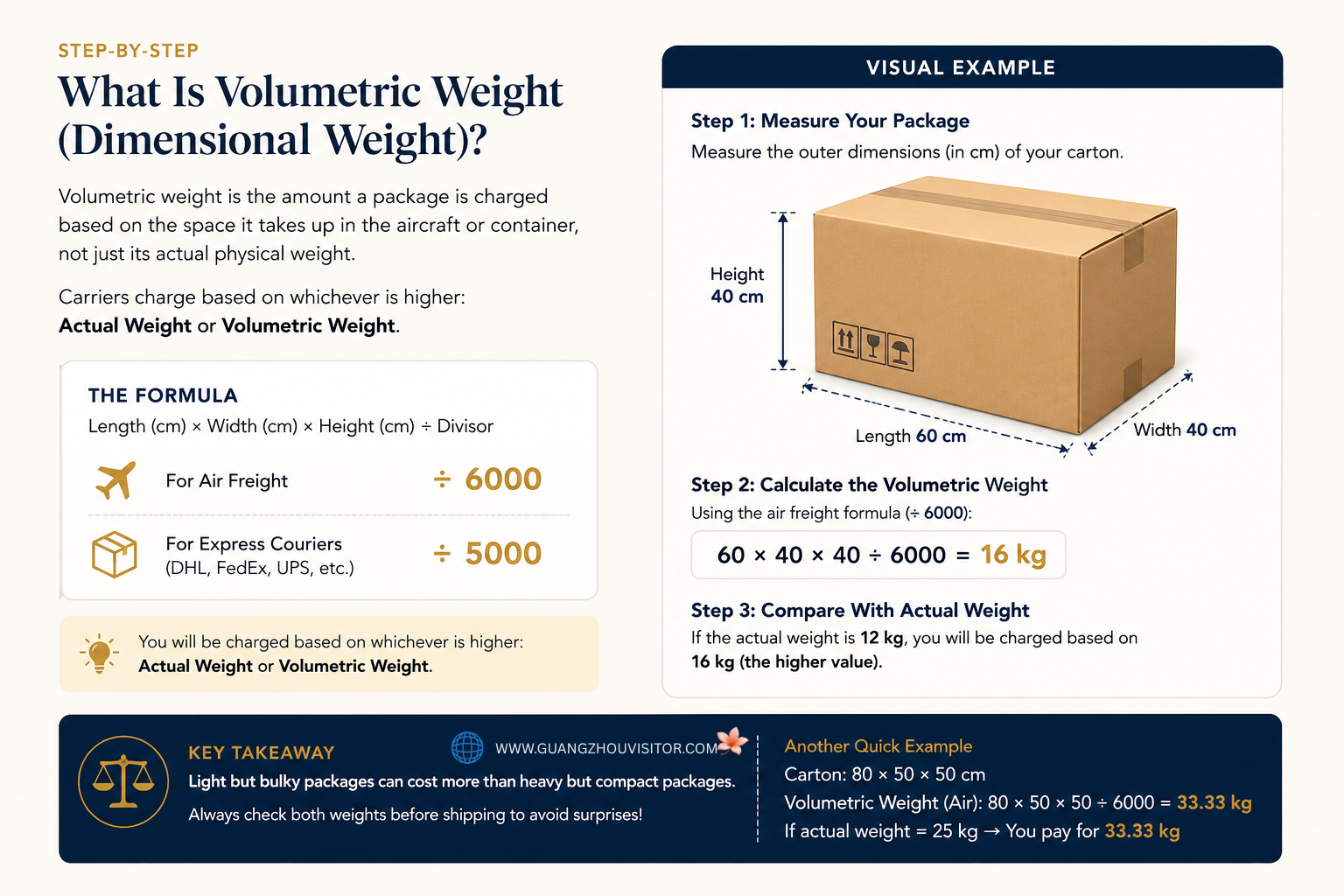
Most first-timers miss this and get surprised by their invoice. Carriers always charge based on whichever is greater: actual weight OR volumetric weight.
📦 Express only (DHL / FedEx / UPS): divide by 5000 instead
Dimensions: 60 × 50 × 40 cm
Vol. weight: 60×50×40 ÷ 6000 = 20 kg
You pay for 20 kg, not 10!
Dimensions: 40 × 30 × 20 cm
Vol. weight: 40×30×20 ÷ 6000 = 4 kg
You pay for 80 kg (actual wins)
👉 Action: Always ask your supplier for exact carton dimensions (L × W × H in cm) AND weight before requesting any freight quote.
Quick Comparison Table
| Method | Transit Time | Cost (est.) | Vol. Formula | Best Use Case |
|---|---|---|---|---|
| 🚢 Sea FCL | 30–45 days | From ~$1,200 (20' container) | CBM × rate | Bulk orders, furniture |
| 🚢 Sea LCL | 35–50 days | $40–100 per CBM | CBM × rate | Mixed goods, 300 kg+ |
| ✈️ Air Freight | 5–10 days | $3–8/kg (EU: $6–8) | L×W×H ÷ 6000 | Electronics, fashion |
| 📦 DHL / FedEx | 3–5 days | $8–15/kg | L×W×H ÷ 5000 | Samples, small orders |
| 📦 China Post | 15–35 days | $1–3/kg | Actual weight | Very small, non-urgent |
Step 2 — Find a Forwarder
Trusted Freight Forwarders
You need a freight forwarder to handle pickup, customs, and delivery. Here are reliable options used by importers from Guangzhou.
- Compare DHL, FedEx, UPS instantly
- Import duties auto-calculated
- Best for small to mid-size shipments
- Real-time tracking included
- Full shipment visibility dashboard
- Good for repeat importers
- Sea & air freight
- Strong US & EU coverage
- Often 20–30% cheaper than big names
- Coordinate via WeChat
- Can pick up directly from markets
- Find through Canton Fair contacts
- All-inclusive door-to-door price
- Handles customs & import duties
- Sea & air from China
- 10+ years experience
Step 3 — Ship Smarter
5 Tips Before You Ship
Most first-timers lose money on shipping. These tips will save you hundreds of dollars.
Example: 50×40×30 cm ÷ 6000 = 10 kg vol. weight. If actual is 5 kg, you pay for 10 kg.
Step 3.5 — Go Deeper
Which Method Actually Fits Your Order?
The table above gives you the numbers. Here's how real importers decide, order by order.
- Your cargo is over 300 kg or 2+ CBM
- You have 4–6 weeks of lead time before you need stock
- You're importing furniture, textiles, or heavy hardware
- Margins are tight and per-kg cost matters more than speed
- Cargo is 100–500 kg and time-sensitive
- You're restocking a bestseller before it sells out
- Goods are electronics, accessories, or anything fragile/high-value
- The cost gap vs. sea is worth 3–4 extra weeks saved
- Cargo is under 100 kg, ideally under 50 kg
- It's a sample, prototype, or first test order
- You need door-to-door tracking with no agent involved
- Speed matters more than the per-kg premium
Decision Table
Full Comparison: Best For, Risks & Tips
The same five methods — now with the risks and pro tips that don't show up in a basic price sheet.
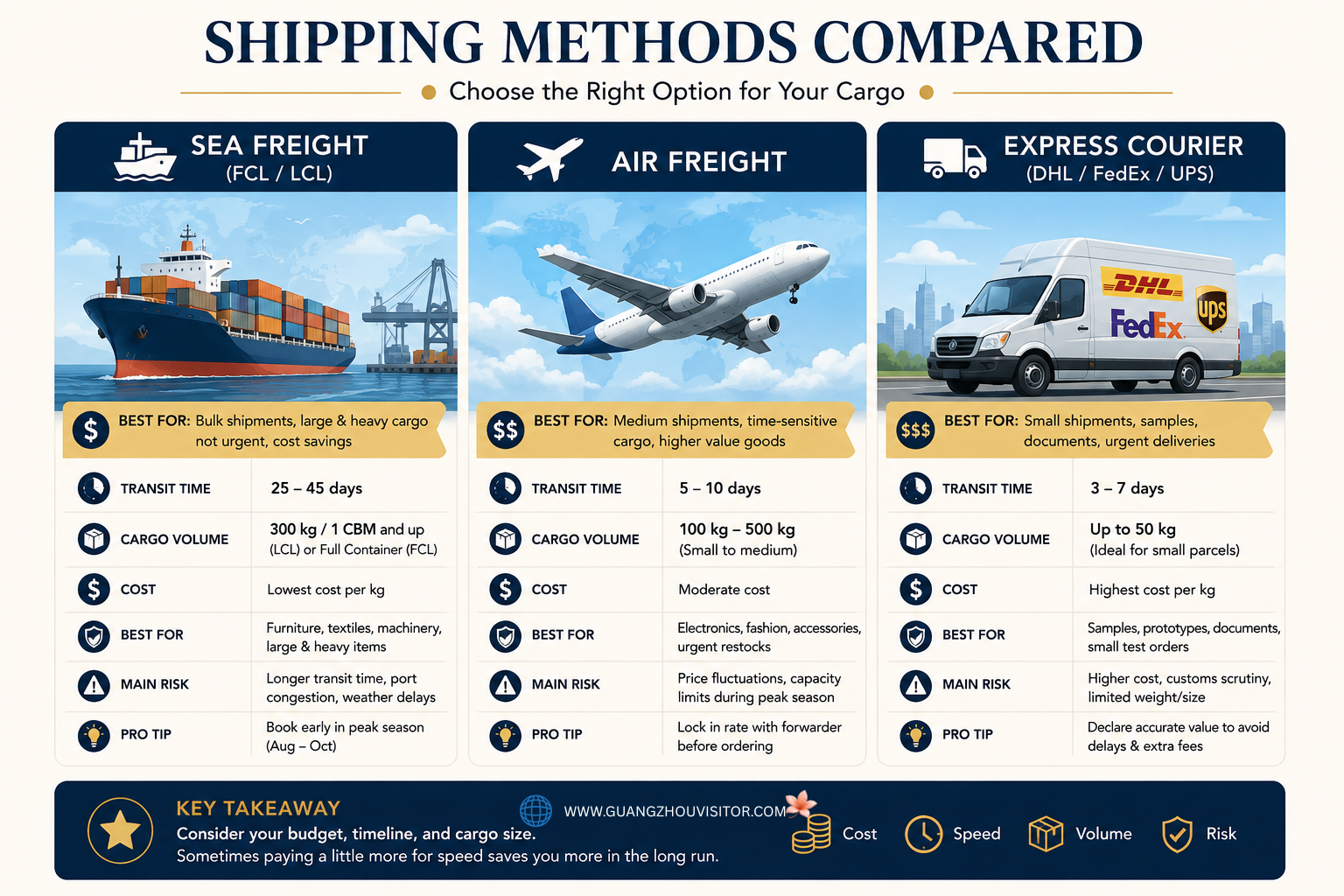
| Method | Best For | Main Risk | Pro Tip |
|---|---|---|---|
| 🚢 Sea FCL | Bulk orders, furniture, one product line filling a full container | Port congestion can add 1–2 weeks with no warning | Book 3–4 weeks ahead during peak season (Aug–Oct) |
| 🚢 Sea LCL | Mixed goods from several suppliers, 300 kg – 2 CBM | Consolidation delays; damage risk from shared container | Ask for photos before container sealing |
| ✈️ Air Freight | Electronics, fashion, urgent restocks 100–500 kg | Price swings sharply around holidays | Lock in rate with forwarder before ordering, not after |
| 📦 DHL / FedEx | Samples, test orders, urgent documents under 50 kg | Higher customs scrutiny can trigger extra duty checks | Declare accurate value — undervaluing risks fines & seizure |
| 📦 China Post | Very small, non-urgent, low-value parcels | Tracking gaps once it leaves China; slow last-mile | Only use for orders you can afford to lose |
Reference
Understanding China's Major Ports
Your forwarder picks the port, but knowing why helps you ask better questions — and spot a bad quote.
👉 If you're sourcing only from Guangzhou markets, Nansha almost always wins on total landed cost. Ask your forwarder to justify any other port.
Contracts 101
Incoterms in Practice, Not Just Definitions
You've seen the terms in the glossary below. Here's what each one actually looks like on a real order.
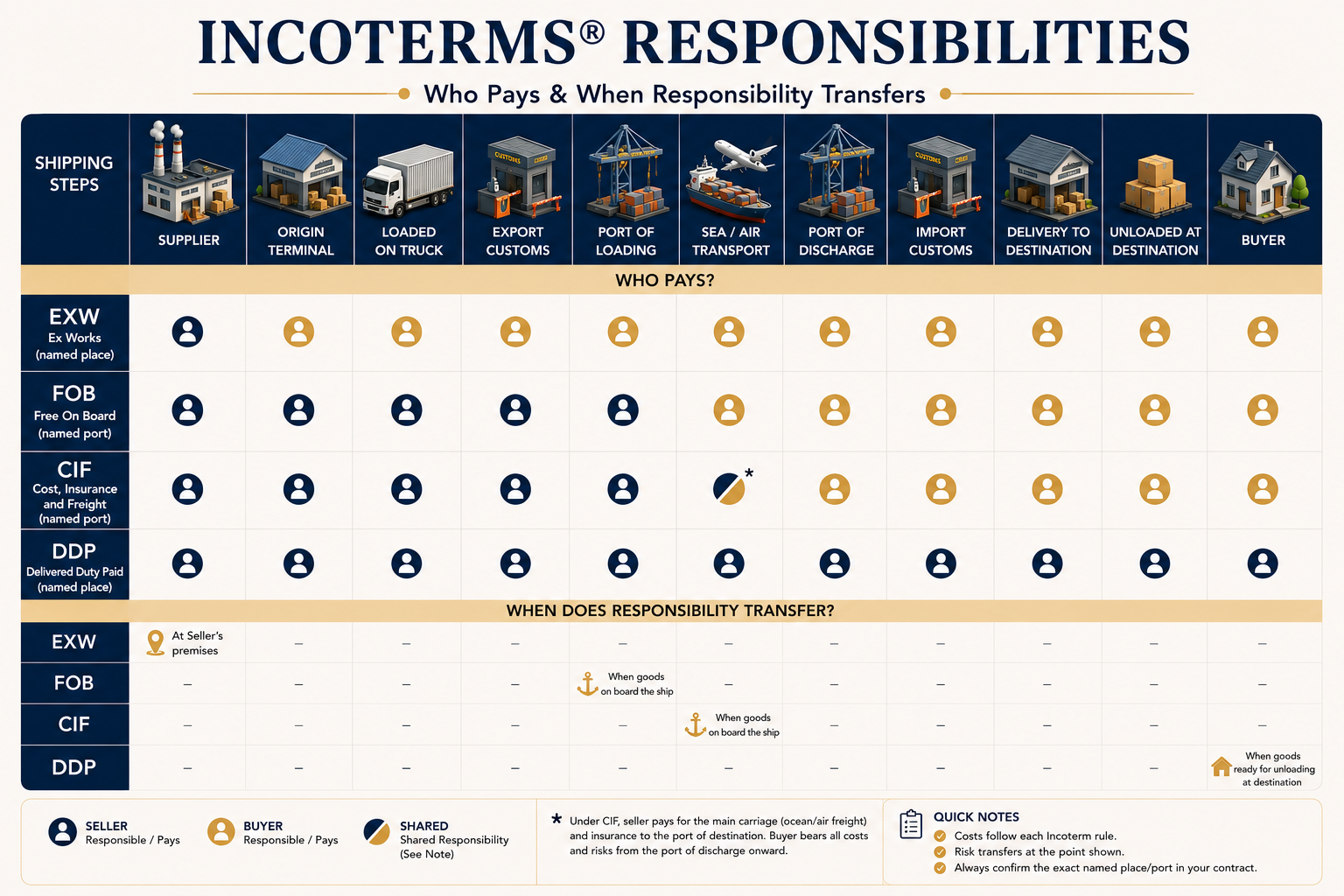
Real Order, Four Ways
Same 500-unit order, priced under each Incoterm.
👉 Rule of thumb: negotiate FOB once you've done 2–3 successful DDP orders and understand your own customs process.
Step-by-Step
How to Calculate Your Customs Duty
Do this math BEFORE you place the order — not after the invoice surprises you.
📊 Worked Example
Order value: $5,000 · Freight: $400 · Insurance: $50
Customs value (CIF) = $5,000 + $400 + $50 = $5,450
Duty rate for this HS code: 15%
VAT/GST (20% on value+duty) = ($5,450 + $817.50) × 20% = $1,253.50
👉 Total landed cost added by customs: ≈ $2,071
Save Money
10 Ways to Cut Your Shipping Costs
Beyond the basics — these add up fast once you're shipping regularly.
Avoid These
5 Mistakes First-Time Importers Make
Each one is fixable — as long as you catch it before you place the order.
Always request exact carton dimensions and run the ÷6000 (or ÷5000 for express) formula before agreeing to a price.
Look up the HS code and duty rate first — a 30% duty can erase your entire margin on thin-margin products.
Confirm what's included: door-to-door, port-to-port, or excluding customs clearance fees?
For any shipment over $2,000, the ~0.5–1% insurance cost is far cheaper than losing the entire order.
Put the agreed Incoterm (FOB, CIF, EXW, DDP) directly on the invoice — verbal agreements cause disputes at the port.
FAQ
Shipping From China: Common Questions
Quick answers to what most importers ask before their first shipment.
Sea freight: 25–45 days door-to-door. Air freight: 5–10 days. Express couriers: 3–7 days, depending on destination country and customs clearance speed.
For sea and air freight, yes — most forwarders include one or can recommend one. For express couriers (DHL/FedEx), clearance is usually handled automatically.
There's no strict minimum, but LCL becomes cost-effective from roughly 300 kg or 1+ CBM. Below that, air or express is usually cheaper overall.
Yes, if they're from the same supplier and ready at the same time. Otherwise, ship samples separately by express so you can inspect quality first.
Ask for an all-inclusive quote in writing covering freight, customs clearance, documentation, and delivery — not just the base freight rate.
Usually yes on paper, but DDP bundles duties and clearance fees you'd otherwise pay separately — so compare total landed cost, not just the quoted price.
Your broker or forwarder will request missing documents or clarify the declared value/HS code. Accurate paperwork upfront is the best way to avoid this.
It's optional but strongly recommended for anything over $2,000 in value — the cost is small relative to the risk of total loss or damage.
Yes — most forwarders can consolidate pickups from multiple suppliers around Guangzhou, including wholesale markets and Canton Fair booths, into a single shipment.
Nansha (Guangzhou) usually offers the lowest total cost for goods sourced in Guangzhou, Foshan, or Dongguan, thanks to shorter inland trucking.
Reference
Shipping Terms Glossary
First time importing? These are the terms you'll encounter in every quote and contract.
Continue Your Journey
Related Guides on GuangzhouVisitor.com
Everything you need before and after your sourcing trip — all in one place.
- Electronics, clothing, bags, furniture
- Addresses & metro directions
- Negotiation tips inside
- Registration & badge process
- Which phases to attend
- Sourcing strategy for first-timers
- Best eSIM for China
- Travel insurance comparison
- Flights & airport transfers
- Medical & trip delay coverage
- Business travel plans available
- Compare EKTA & more
📘 Ready to Ship With Confidence?
Get the complete import playbook — sourcing, shipping, and customs — in one place.
Also see: Wholesale Markets Guide · Canton Fair Guide
🤝 Tools We Recommend for Your Sourcing Trip
Trusted by importers visiting Guangzhou. Some links are affiliate links — at no extra cost to you.