Canton Fair 140: What Buyers Need to Do Right Now
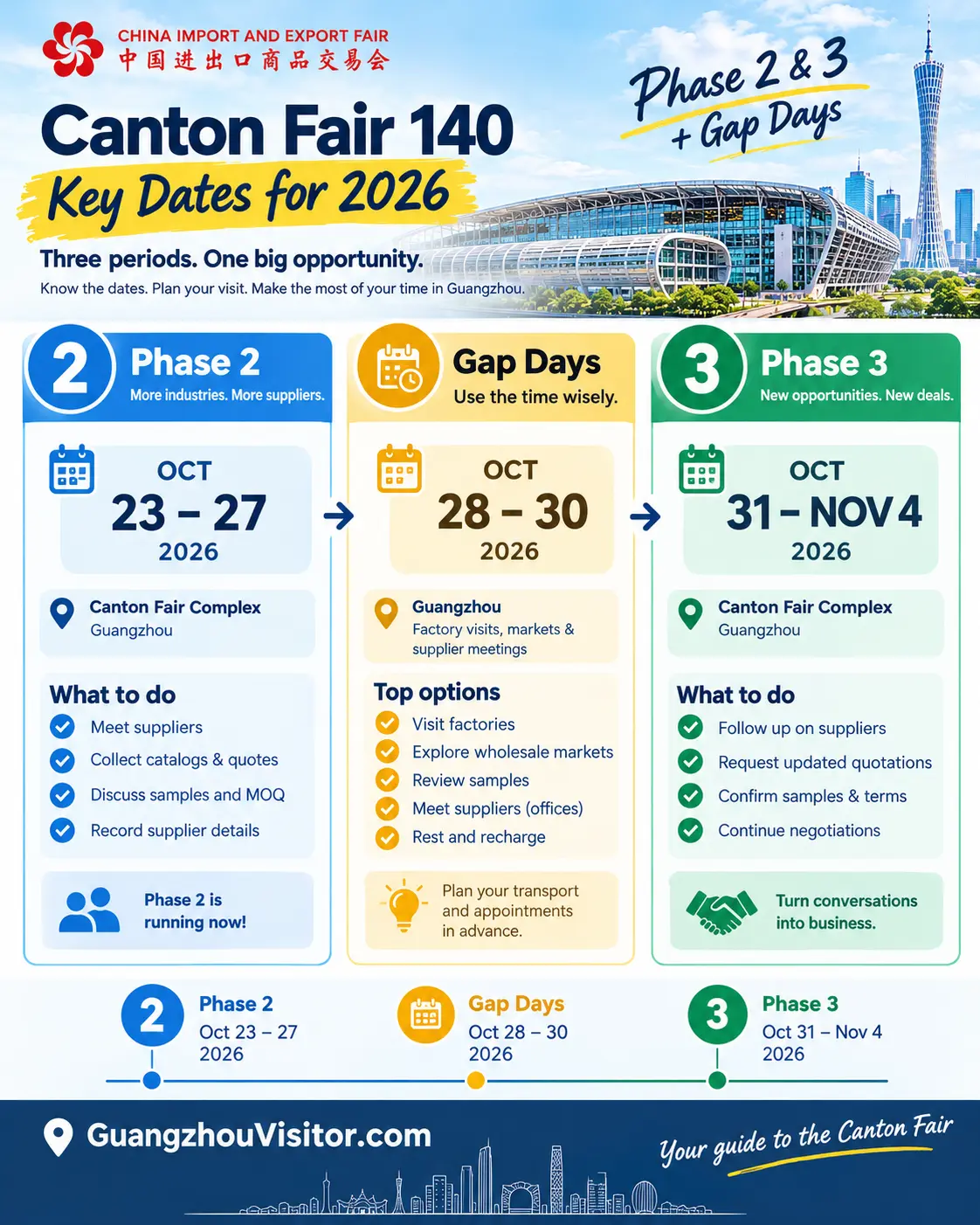
Phase 2 of the 140th Canton Fair runs from October 23–27, 2026. Phase 3 begins on October 31 and ends on November 4.
That leaves three days, October 28–30, between the two phases.
October 23–27, 2026
October 28–30, 2026
October 31 – November 4, 2026
If you are already in Guangzhou or arriving for Phase 3, this is your practical action plan. You do not need another long preparation guide. You need working payment options, a reliable way to contact suppliers, and a clear plan for turning booth conversations into real business opportunities.
This guide covers four essentials:
- Digital payments, messaging apps, and navigation.
- Five ready-to-send supplier messages in English and Simplified Chinese.
- Seven common buying mistakes and how to avoid them.
- Practical ways to use the October 28–30 gap days.
New to the Canton Fair? Start with our Canton Fair 2026 Phases Explained guide and Weekly Preparation Plan for Canton Fair 140 before continuing.
Related guide: Canton Fair Guide
Official dates and exhibition information: Canton Fair Official Website.
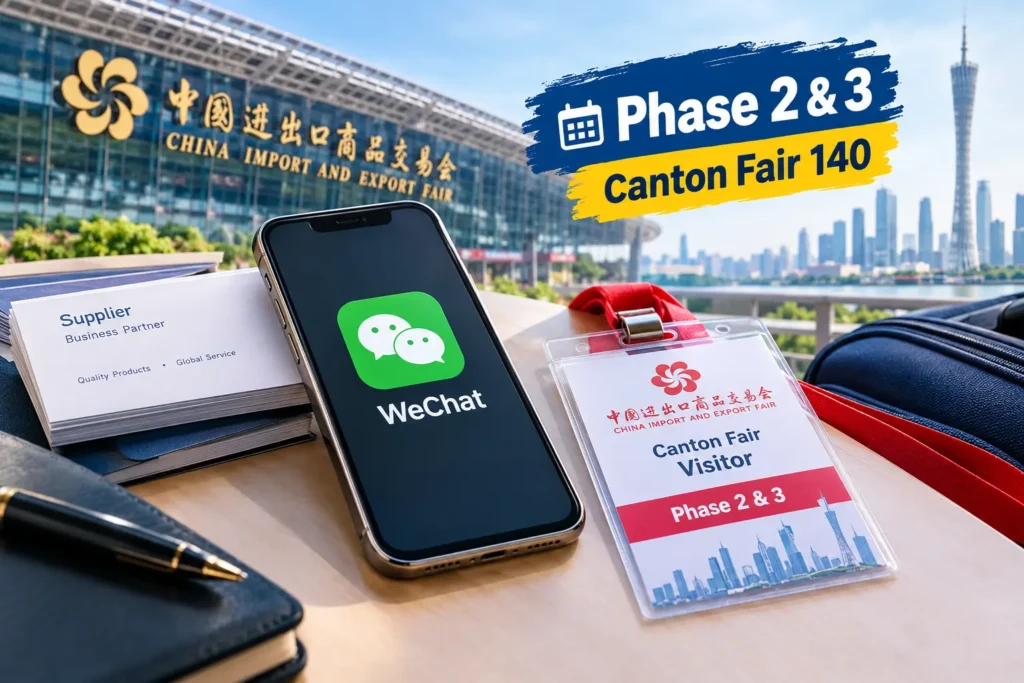
Part 1: Digital Setup — Get These Essentials Ready
Your phone is one of your most useful business tools in China. It helps you pay for everyday purchases, communicate with suppliers, find locations, and keep track of quotations.
The Three Essential Apps
Everyday payments and supported local services.
Supplier communication, catalogs, photos, and follow-ups.
Local navigation and finding addresses in China.
Install and test these apps before leaving your hotel whenever possible.
Alipay Setup
Allow approximately 10–15 minutes if everything goes smoothly.
- Download Alipay from your official app store.
- Register using your mobile number, following the app’s instructions.
- Complete identity verification if requested.
- Open Me → Bank Cards, or the equivalent option in your current app version.
- Add an eligible international bank card and complete any required verification.
- If possible, test a small payment at a participating merchant.
Important: International card acceptance depends on the card network, issuing bank, account verification, and merchant. Linking a card does not guarantee that every transaction will work. Check the current fees and transaction limits shown by the app.
Related guide: How to Link Your Wise Card to Alipay in China
WeChat Setup
WeChat is particularly useful for building supplier relationships.
- Download WeChat and register using your mobile number.
- Complete any verification requested by the app.
- Open the Services or Wallet section, if available in your account.
- If you intend to use WeChat Pay, follow the current instructions to link an eligible international bank card.
- Exchange contact details with suppliers and save their profiles immediately.
You do not need WeChat Pay to use WeChat for ordinary supplier messaging. Payment functionality and menu availability may vary by account and region.
For more information, consult the Chinese Government’s Guide to Payment Services for Overseas Visitors.
Related guide: China Travel Essentials
Mobile Internet: Check Your eSIM Before Traveling
If you have not arranged mobile data, check your options before arriving. Providers to compare include Ubigi, Nomad, Airalo, and Holafly. Availability and network routing vary by plan.
Before purchasing:
- Confirm that the plan covers mainland China.
- Check whether your phone supports eSIM.
- Install the eSIM over Wi-Fi if the provider permits it.
- Follow the provider’s instructions for activating data roaming.
- Check whether your chosen plan allows access to the services you need.
Do not assume that every China-compatible eSIM provides the same access to websites and apps. Verify the provider’s current terms and routing details before paying. Keep your hotel Wi-Fi details available as a backup.
Compare eSIM data plans for China before you land, and keep your hotel Wi-Fi as a backup.
Get an Airalo eSIMAffiliate link — at no extra cost to you.Related guide: China SIM Card and eSIM Guide
Cash Backup
Carry approximately ¥200–¥500 in smaller RMB notes for emergencies and situations where digital payments are inconvenient.
Cash remains an important payment option in China, but carrying smaller denominations can make everyday purchases easier. You can also keep an eligible bank card as a backup. Do not rely exclusively on a single app or payment method.

Part 2: Five Copy-and-Paste WeChat Messages for Suppliers
Meeting suppliers is only the first step. What happens after the meeting often determines whether a promising conversation becomes a real purchasing opportunity.
These templates help you request quotations, samples, production information, and follow-up documents without sending vague messages.
How to use: choose English or Simplified Chinese, tap Copy message, then replace every item in [brackets] before sending.
Script 1: First Contact After Meeting at a Booth
Script 2: Requesting a Product Sample
Script 3: Negotiating Price and MOQ
Script 4: Requesting a Factory Visit During the Gap Days
Script 5: The 48-Hour Follow-Up
WeChat Etiquette: Five Practical Rules
Your real name and company name help suppliers identify you.
Record the supplier’s name, company, booth number, and product category.
One clear message is usually better than many short messages.
Written details are easier to review, translate, and reference later.
A timely, specific reply helps maintain the business conversation.
You can also send a photo of the supplier’s business card with a short message confirming where you met.
Related guide: The Guangzhou Insider’s Import Bible
Part 3: Seven Mistakes That Can Cost Buyers Time and Money
1. Assuming Every Exhibitor Is a Manufacturer
Some exhibitors manufacture products themselves. Others are trading companies, sourcing agents, or distributors.
A trading company is not automatically a bad supplier. It may offer a broader product range or coordinate several factories. The important point is to understand who will actually produce your order and who is responsible for quality.
Ask:
“Are you the manufacturer or a trading company? If you work with a factory, can you share its location and arrange a visit?”
请问贵公司是生产厂家还是贸易公司?如果您与工厂合作,能否提供工厂地址并安排参观?
Verify the answer rather than assuming that hesitation proves anything.
2. Agreeing on a Sample Without Checking Bulk Pricing
A sample price does not tell you what a commercial order will cost.
Before paying for a sample, request a quotation at your intended order quantity. Confirm whether the sample fee can be credited toward a future order. Compare the complete commercial terms, not just the unit price.
3. Skipping Quality Control
A sample may not represent the quality of a later production run. Before placing a significant order:
- Agree on written product specifications.
- Approve a reference sample where appropriate.
- Confirm packaging, labeling, and acceptable defect criteria.
- Consider an independent inspection before shipment.
Inspection providers include SGS, QIMA, and Bureau Veritas. Check their current services, availability, and fees for your product and location. For regulated products, confirm the applicable compliance requirements in your destination market before ordering.
Related guide: Import Checklists
4. Failing to Record Supplier Details
After meeting dozens of exhibitors, it is easy to confuse products, prices, and contacts. Create a simple spreadsheet with these columns:
| Field | What to Record |
|---|---|
| Supplier | Company name and contact |
| Location | Hall and booth number |
| Product | Model and specifications |
| Price | Unit price and quoted quantity |
| MOQ | Minimum order quantity |
| Lead time | Estimated production time |
| Sample | Requested, paid, or received |
| Verification | Documents and checks pending |
| Next action | Follow-up date and outstanding questions |
Update the sheet every evening. A few minutes of organization can save hours of searching later.

5. Paying Unverified Fees for an Invitation Letter
The Canton Fair provides an official Buyer Service System through which eligible overseas buyers can apply for invitation letters and manage attendance-related services.
Start with the official invitation application guide.
Before paying an agency, ask what service it provides, whether the fee is mandatory, and whether the same service is available directly through the official system.
Do not assume that every quoted fee is fraudulent, but do not pay for an unnecessary service without checking the official requirements first.
Related guide: Canton Fair M Visa Guide 2026
6. Ignoring Shipping and Import Costs
A low factory price can become an expensive order once transportation, insurance, customs duties, and other costs are included. Before committing, confirm:
- The agreed Incoterm, such as EXW, FOB, or CIF.
- Carton dimensions, gross weight, and total shipment volume.
- Whether the quotation includes packaging and export-related charges.
- Shipping options, transit estimates, and insurance.
- Customs duties, taxes, and product compliance requirements in your country.
Ask a freight forwarder for a written estimate based on the actual shipment details.
Related guide: Shipping & Logistics · Smart Import Hub
7. Waiting Too Long to Follow Up
Suppliers may meet many potential buyers during the fair. A vague message sent weeks later is unlikely to be as useful as a clear follow-up sent while the meeting is still fresh.
Within 24–48 hours of meeting a promising supplier, remind them who you are, identify the product, and request the exact documents you need. Use Script 5 above, then maintain a realistic follow-up schedule.
The goal is not to rush into an order. It is to keep the evaluation process moving.
Part 4: How to Use the October 28–30 Gap Days
Phase 2 ends on October 27, and Phase 3 begins on October 31. These three days can be useful for supplier meetings, sample evaluation, factory visits, and sourcing outside the exhibition.
However, do not assume every factory or market will operate according to your preferred schedule. Confirm appointments, opening hours, addresses, and transport before traveling.
Option 1: Arrange Factory Visits
A factory visit can help you understand production capacity, equipment, quality-control procedures, and packaging operations. Before confirming the visit:
- Ask for the complete address and a named contact.
- Confirm the appointment in writing.
- Check the journey time from Guangzhou.
- Ask whether photography is permitted.
- Prepare specific questions about production, quality, and order requirements.
Factories may be located outside Guangzhou, so check whether the trip is realistic within your available time.
Option 2: Visit a Specialized Wholesale Market
Guangzhou has wholesale districts specializing in different product categories. Choose a market based on what you intend to buy rather than trying to visit several unrelated locations in one day.
For every market visit, check the route and transport cost in advance. Do not assume that free shuttle buses serve wholesale markets unless the official transport information confirms the relevant route.
Related guide: Guangzhou Wholesale Markets Guide
Option 3: Meet Suppliers Outside the Exhibition
A meeting at a supplier’s office may allow more time to discuss specifications, payment terms, customization, and delivery schedules. Arrange the meeting in advance and ask the supplier to confirm the location and the person you will meet. Bring your notes from the exhibition so you can compare offers consistently.
Option 4: Review Samples and Shortlist Suppliers
Use the gap days to organize the information you have collected. For each shortlisted product, review:
- Whether the sample matches your requirements.
- Whether the quoted price is competitive at your target quantity.
- Whether the supplier has provided relevant documentation.
- Whether production and delivery schedules meet your needs.
- Whether any important questions remain unanswered.
Avoid placing a large order simply because you have limited time before Phase 3.
Option 5: Travel to Another City Only With a Confirmed Plan
Shenzhen, Dongguan, and Foshan may be relevant depending on your product category and supplier locations.
High-speed rail can be useful for some journeys, but total travel time includes getting to the station, security checks, transfers, and reaching the final destination. Check the actual route and schedule before committing to a factory appointment. A distant factory visit may be less productive than a well-prepared meeting in Guangzhou.

Unlock the history behind the city. Book guided day tours, historic site visits, and stunning traditional performances highly recommended by fellow travelers.
Book ExperienceAffiliate link — at no extra cost to you.Your Last-Minute Canton Fair Checklist
Use this checklist before your next exhibition day. Tap an item to tick it off; your progress is kept on this device.
0 of 14 completed
Still need a place to stay near the exhibition complex? See our Top 10 Business Hotels near Pazhou guide.
Compare business hotels close to the Pazhou complex and metro access before Phase 3.
View Hotels on Trip.comAffiliate link — at no extra cost to you.Final Takeaway: Turn Supplier Meetings Into Business Opportunities
The Canton Fair is an opportunity to discover products and build relationships, but collecting business cards is only the beginning.
Focus on three essentials:
Prepare your messaging, navigation, and payment options.
Capture supplier names, booth numbers, product specifications, prices, and outstanding questions.
Request written quotations, samples, specifications, and clear commercial terms before making a commitment.
Use the October 28–30 gap days strategically, whether that means visiting a factory, meeting a supplier, or evaluating the options you discovered during Phase 2.
You do not need to finalize every deal at the fair. You need reliable information and a clear process for deciding which suppliers deserve the next step.
Sources and Editorial Note
- Canton Fair Official Website — dates and exhibition information.
- Canton Fair invitation application guide.
- Chinese Government's Guide to Payment Services for Overseas Visitors.
This guide is written for buyers attending Phase 2 (October 23–27) and Phase 3 (October 31–November 4) of the 140th Canton Fair in 2026. Dates, app features, payment conditions, market locations, and transport arrangements can change. Verify important details through official sources before making travel or purchasing decisions.
🇨🇳 Related China Travel Guides
More essential guides to help you prepare for your China trip.