China 240-Hour Visa-Free Transit: Complete Guide for 2026
Who qualifies, the 57 eligible countries, entry requirements, Guangzhou and Guangdong ports, allowed areas, how the 240 hours are calculated, and common mistakes to avoid
Planning a trip to China but don’t want to apply for a Chinese visa?
If you are a passport holder from one of 57 eligible countries, China’s 240-hour visa-free transit policy may allow you to enter China without obtaining a visa in advance — provided your itinerary meets the transit requirements.
The policy allows eligible travelers to stay in designated areas of China for up to 240 hours (10 days) while traveling onward to a third country or region.
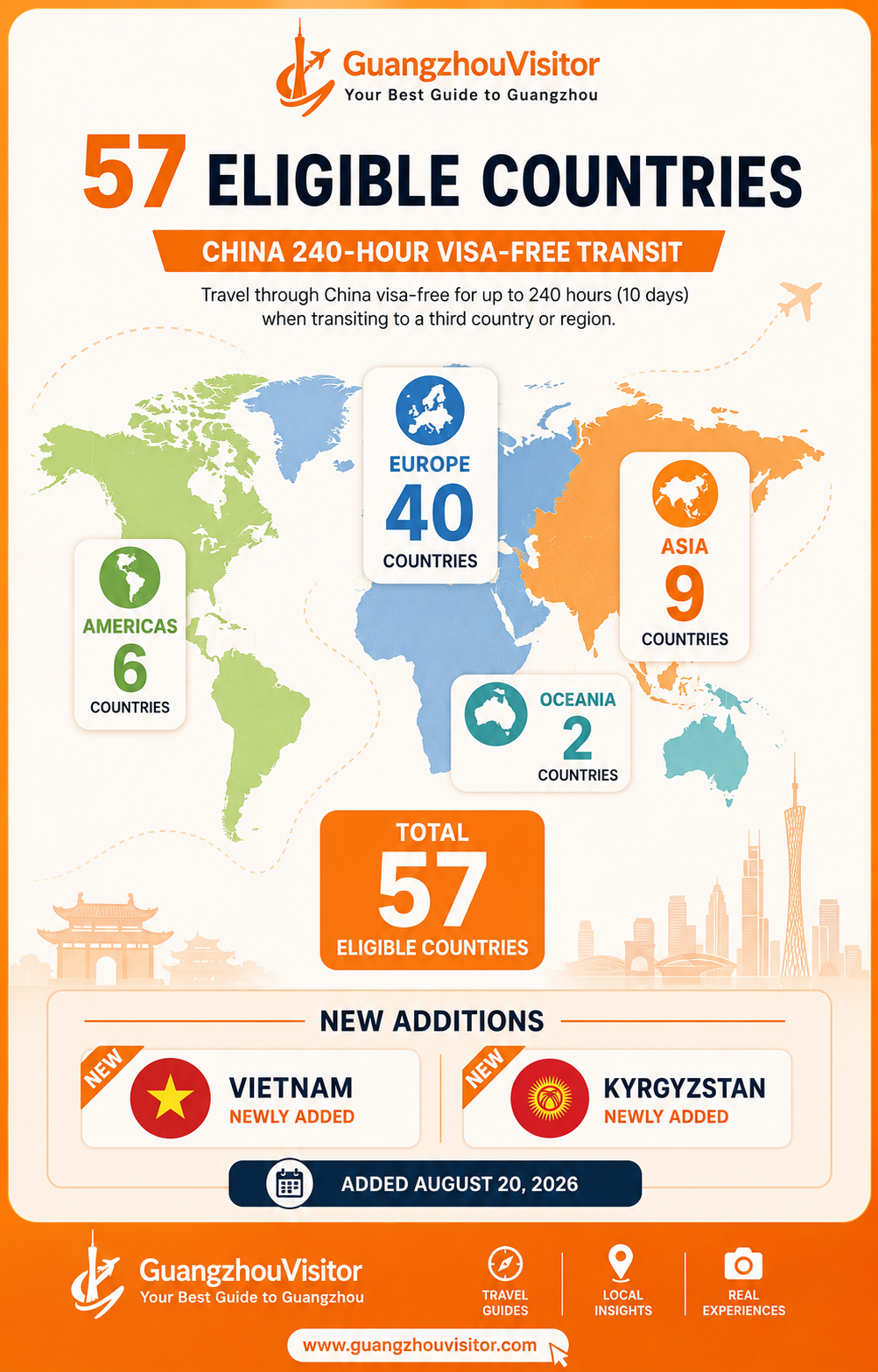
The rules have expanded significantly in recent years. As of August 20, 2026, nationals of 57 countries are eligible, including France, Germany, the United Kingdom, the United States, Australia, Japan, Singapore, Vietnam and Kyrgyzstan. Travelers can use one of 65 designated entry ports across 24 provincial-level regions.
For travelers visiting Guangzhou, Shenzhen, or other parts of Guangdong, this policy can be particularly useful because Guangdong has multiple designated entry ports, including Guangzhou Baiyun International Airport.
This guide explains exactly how the 240-hour transit policy works in 2026, who qualifies, what documents you need, where you can go, and how to avoid the most common problems at check-in and immigration.
QCan You Enter China Without a Visa for 10 Days?
Yes, if you meet all of the requirements.
The 240-hour visa-free transit policy generally requires you to:
- Hold an ordinary passport from one of the 57 eligible countries
- Have a valid international travel document
- Be traveling from one country/region through China to a different third country/region
- Have a confirmed onward ticket with a specified date and itinerary
- Enter through one of the 65 designated ports
- Stay within the permitted areas during your visa-free period
- Leave China within the permitted 240-hour period
During the visa-free stay, travelers may generally engage in tourism, business, visiting friends or relatives, and other permitted short-term activities. However, activities such as employment, formal study, and news reporting that require prior approval still require the appropriate Chinese visa.
Not sure this is the right policy for your trip? This guide is part of our China Visa series:

1What Is China’s 240-Hour Visa-Free Transit Policy?
China’s 240-hour visa-free transit policy allows eligible foreign nationals to enter China without obtaining a visa beforehand when they are transiting through China to a third country or region.
The policy was expanded in December 2024, when China increased the maximum transit stay from the previous 72-hour and 144-hour systems to 240 hours (10 days) and expanded the number of applicable entry ports and permitted areas.
The program has subsequently expanded further. On August 20, 2026, China added Vietnam and Kyrgyzstan, bringing the total number of eligible countries to 57.
2Who Can Use the 240-Hour Visa-Free Transit Policy?
You may qualify if:
- Your nationality is on China’s list of 57 eligible countries.
- You hold an ordinary passport.
- Your passport/travel document is valid and meets China’s entry requirements.
- You are traveling onward to a third country or region.
- Your onward journey has a confirmed date and itinerary.
- You enter through one of the designated ports.
- Your stay remains within the permitted area.
The National Immigration Administration currently lists 57 eligible countries.
3The 57 Countries Eligible in 2026
As of August 20, 2026, the eligible countries are:
Europe — 40 countries
- Austria
- Belgium
- Czech Republic
- Denmark
- Estonia
- Finland
- France
- Germany
- Greece
- Hungary
- Iceland
- Italy
- Latvia
- Lithuania
- Luxembourg
- Malta
- Netherlands
- Poland
- Portugal
- Slovakia
- Slovenia
- Spain
- Sweden
- Switzerland
- Monaco
- Russia
- United Kingdom
- Ireland
- Cyprus
- Bulgaria
- Romania
- Ukraine
- Serbia
- Croatia
- Bosnia and Herzegovina
- Montenegro
- North Macedonia
- Albania
- Belarus
- Norway
Americas — 6 countries
- United States
- Canada
- Brazil
- Mexico
- Argentina
- Chile
Oceania — 2 countries
- Australia
- New Zealand
Asia — 9 countries
- South Korea
- Japan
- Singapore
- Brunei
- United Arab Emirates
- Qatar
- Indonesia
- Vietnam — NEW
- Kyrgyzstan — NEW
The list above reflects the National Immigration Administration’s August 20, 2026 update.
4The Most Important Rule: You Must Be Transiting to a Third Country or Region
This is the part that causes the most confusion. The basic concept is:
Eligible example
France is your origin, China is the transit point, and Japan is your onward destination.
Another example
This can fit the transit structure if all other requirements are met.
Another example
Again, China is the transit point between two different countries/regions.
What Does NOT Normally Qualify?
A simple:
does not satisfy the basic third-country/region transit requirement.
Likewise:
does not create the required third-country/region transit itinerary.
The key concept is that the traveler must be transiting through China to a different third country or region.
5What Counts as a “Third Country or Region”?
This is another area where travelers can become confused. The important point is that the onward destination must be different from the country or region from which you entered China.
Special travel arrangements involving regions such as Hong Kong and Macau can require careful itinerary checking. Do not assume that every combination of mainland China, Hong Kong and Macau automatically qualifies.
If your itinerary involves:
- Mainland China
- Hong Kong
- Macau
- Taiwan
or multiple separate tickets, verify the exact itinerary with the airline and Chinese immigration authorities before departure. This is especially important because the transit policy is based on the actual entry and onward travel arrangement, not simply on how many flights you have booked.
6What Documents Do You Need?
Before flying to China, prepare the following.
1. Eligible passport — You need an ordinary passport from one of the 57 eligible countries.
2. Valid travel document — Your passport must satisfy China’s entry requirements.
3. Confirmed onward ticket — You need a confirmed onward journey to a third country or region with a specified date and itinerary.
4. Proof of your itinerary — Keep your complete flight or transportation itinerary available, preferably both digitally and offline.
5. Accommodation information — Although the visa-free transit policy is primarily based on nationality and transit eligibility, having your hotel reservation and local address available can make immigration procedures easier.
6. Arrival information — Foreign travelers may complete the China arrival card online before arrival through official immigration channels, or complete the required procedure at the port if necessary. China introduced online foreigner arrival-card reporting in November 2025.
7Do You Need to Apply for the 240-Hour Visa-Free Transit in Advance?
Generally, there is no separate visa application that you submit at a Chinese embassy before your trip for the 240-hour transit exemption. The immigration authorities process the temporary entry formalities when you arrive at the designated port.
However, this does not mean you can simply arrive in China without preparing anything. Your airline may verify your eligibility before boarding, so you should have:
- Your passport
- Your onward ticket
- Your complete itinerary
- Proof of your eligibility
- Hotel/accommodation information
ready at check-in. The final decision on admission is made by the Chinese immigration authorities.
8How Is the 240 Hours Calculated?
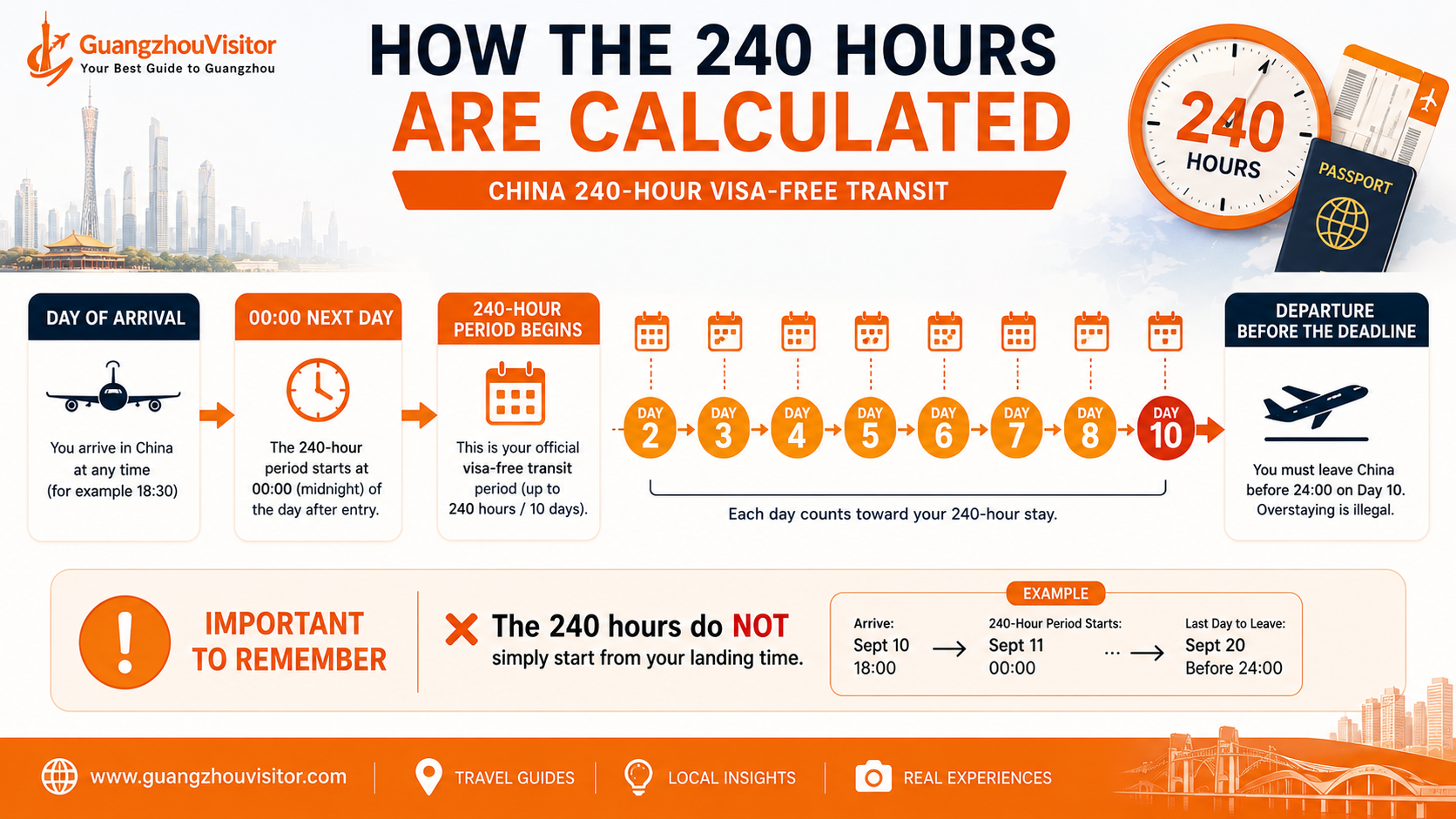
This is one of the most important details. The 240-hour period is not simply a rolling 240 hours from the moment your plane lands.
Under the current implementation, the visa-free stay period is calculated from 00:00 on the day following the day of entry.
Practical advice: Never plan your onward flight for the last possible minute. Give yourself a reasonable buffer for:
- Airport queues
- Immigration
- Security
- Flight delays
- Transportation problems
- Weather disruptions
9Where Can You Enter China Under the 240-Hour Policy?
As of August 2026, the policy applies through 65 designated open ports in 24 provincial-level regions. The system includes major gateways such as:
- Beijing
- Shanghai
- Guangzhou
- Shenzhen
- Chengdu
- Chongqing
- Xi’an
- Kunming
- Zhangjiajie
- Guilin
- Haikou
- Sanya
- and other designated locations
The exact list of ports and permitted areas should always be checked against the latest National Immigration Administration information before travel.
10Guangzhou and Guangdong: What Travelers Need to Know
For GuangzhouVisitor readers, this is one of the most useful sections. Guangdong is one of the regions covered by the 240-hour visa-free transit system.
Designated Guangdong entry ports include:
- Guangzhou Baiyun International Airport
- Shenzhen Bao’an International Airport
- Jieyang Chaoshan International Airport
- Nansha Port (Passenger)
- Shekou Port (Passenger)
- Guangzhou Pazhou Ferry Terminal
- Zhongshan Port (Passenger)
- Hengqin Port
- Hong Kong-Zhuhai-Macao Bridge Port
- West Kowloon Station Port of the Guangzhou-Shenzhen-Hong Kong Express Rail Link

The five additional Guangdong ports — including Guangzhou Pazhou Ferry Terminal, Hengqin, Hong Kong-Zhuhai-Macao Bridge, Zhongshan Port and West Kowloon Station — were added in November 2025, bringing the national total to 65 designated entry ports.
Why Guangzhou is particularly useful
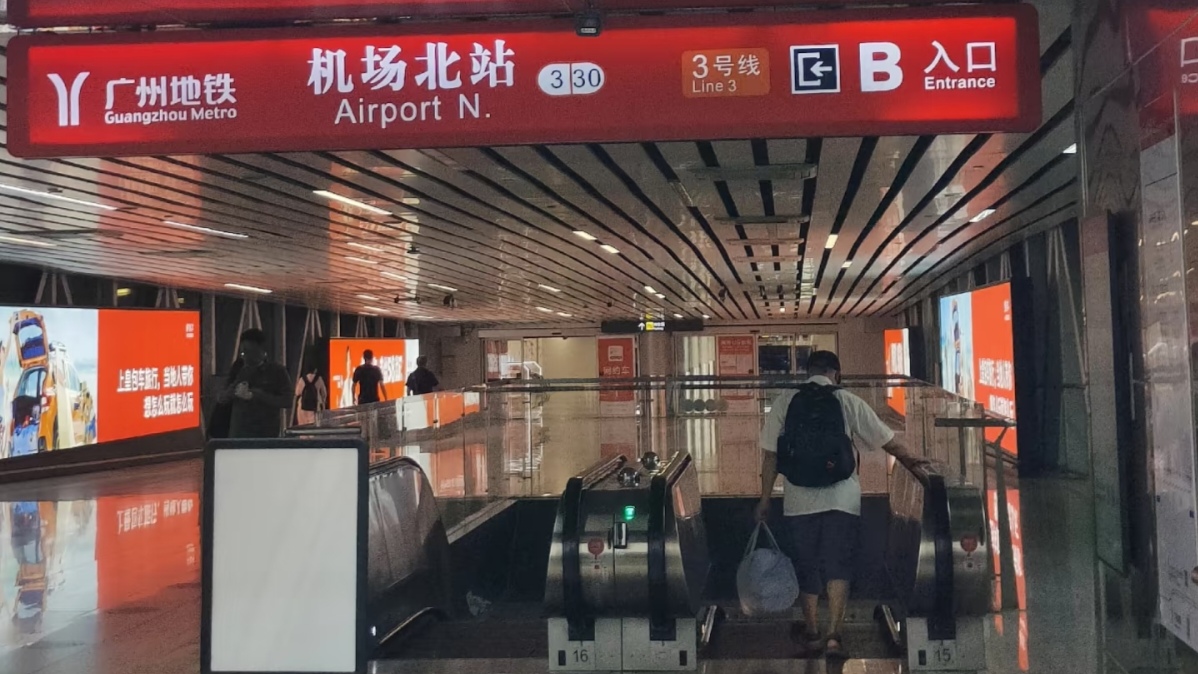
For international travelers, Guangzhou Baiyun International Airport (CAN) provides a major gateway into southern China.
If your itinerary qualifies, you could potentially use Guangzhou as the China portion of a trip such as:
or
This makes Guangzhou a useful stopover for travelers who want to combine a China visit with another Asian destination.
Landing at Baiyun and want the full arrival walkthrough — terminals, metro, taxi, and intercity rail? See our Guangzhou Airport Arrival Guide.
11Can You Visit Guangzhou for Tourism Under the 240-Hour Policy?
Yes, tourism is one of the permitted short-term activities under the policy. During an eligible visa-free transit stay, travelers may engage in tourism, business, visits and family visits.
This makes the policy potentially useful for travelers who want to spend several days exploring Guangzhou instead of simply connecting at the airport. Possible Guangzhou experiences include:
- Canton Tower
- Pearl River
- Beijing Road
- Shamian Island
- Chen Clan Ancestral Hall
- Guangzhou’s traditional neighborhoods
- Canton Fair Complex and Pazhou area
- Wholesale markets
- Food tours
- Day trips within the permitted area
Planning to shop while you’re there? See our Guangzhou Wholesale Markets Guide.
For business travelers, Guangzhou can also be useful as a short stop for supplier meetings, factory visits, market research, trade fairs, and business networking. However, employment and other activities requiring prior approval are not covered simply because you entered visa-free.

Guangzhou Culture Tour
Book a guided tour of Canton Tower, Shamian Island and the old town — ideal for a transit stopover.
12Can You Visit Other Cities During Your Stay?
This depends on the permitted stay area associated with the port and the policy rules in force for that region. This is an important distinction:
For example, being admitted through Guangzhou does not automatically mean you can assume that Beijing, Shanghai or every other Chinese province is available to you. Always check the current permitted-area rules before planning an itinerary across multiple provinces.
13Can You Travel by Train During the 240-Hour Stay?
The policy is not limited to airplanes. China’s transit system covers international air, sea and rail transportation in the relevant transit framework, and the designated entry-port system includes airport, port and rail gateways.
Once legally admitted, travelers may use China’s domestic transportation system where permitted by the rules governing their stay. However, your domestic travel does not override the geographical restrictions of the visa-free transit policy.

China’s Luxury Bullet Train
Book intercity rail tickets in advance if your transit itinerary includes onward travel by high-speed rail.
14Can You Stay in a Hotel?
Yes. Eligible travelers can stay in hotels during their permitted visa-free stay. Hotels generally handle the required foreign guest accommodation registration.
If you stay in private accommodation rather than a hotel, you may need to complete accommodation registration with the local public security authorities. For this reason, travelers staying with friends or relatives should check the local registration procedure rather than assuming the hotel process applies automatically.
15Can You Use the Policy for Business Travel?
Yes. Short-term business activities are among the activities permitted under the 240-hour visa-free transit policy. This can be particularly valuable for Guangzhou, Shenzhen and other major commercial areas. Potential activities include:
- Supplier meetings
- Business discussions
- Trade-fair attendance
- Market research
- Factory visits
- Visiting business partners
However, the policy should not be treated as a substitute for a work visa. If your activity amounts to employment or another activity requiring prior authorization, you should obtain the appropriate visa before traveling.
Coming for the fair? See our Canton Fair Guide for hall maps, timing, and insider tips.
16What You Cannot Do Under the 240-Hour Transit Exemption
The visa-free transit exemption is not an unlimited permission to live or work in China. You should not use it for activities that require a specific Chinese visa, including:
Employment — Working for a Chinese company or taking up employment is not permitted simply because you entered under the transit exemption.
Formal study — Academic study requiring a student visa is not covered.
News reporting — Journalistic activities requiring prior authorization require the appropriate visa.
China’s National Immigration Administration specifically states that work, study and news reporting requiring prior approval still require the appropriate visa.
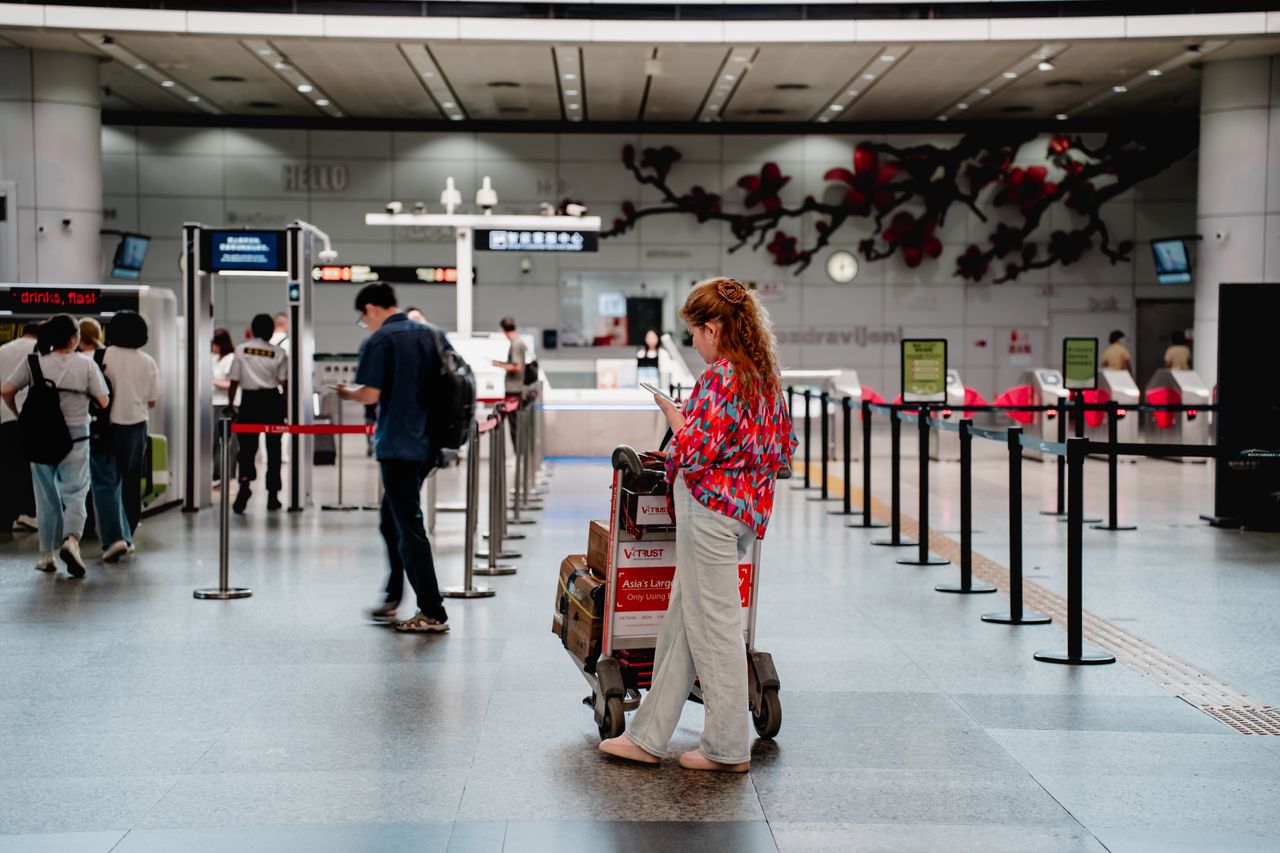
17What Happens at the Airport?
Your experience will generally involve several steps.
Step 1 — Airline check-in. The airline checks your passport and onward itinerary.
Step 2 — Arrival in China. Follow signs for immigration and visa-free transit/transfer procedures.
Step 3 — Immigration inspection. Present your passport, onward ticket, travel itinerary, and other supporting documents if requested.
Step 4 — Temporary entry processing. If you qualify, Chinese immigration authorities process the temporary entry formalities.
Step 5 — Enter China. Once approved, you can enter and begin your permitted stay.
18Common Reasons Travelers Get Confused or Refused
One of the best ways to make this article useful is to explain what can go wrong.
19240-Hour Visa-Free Transit vs. China’s Other Visa-Free Options
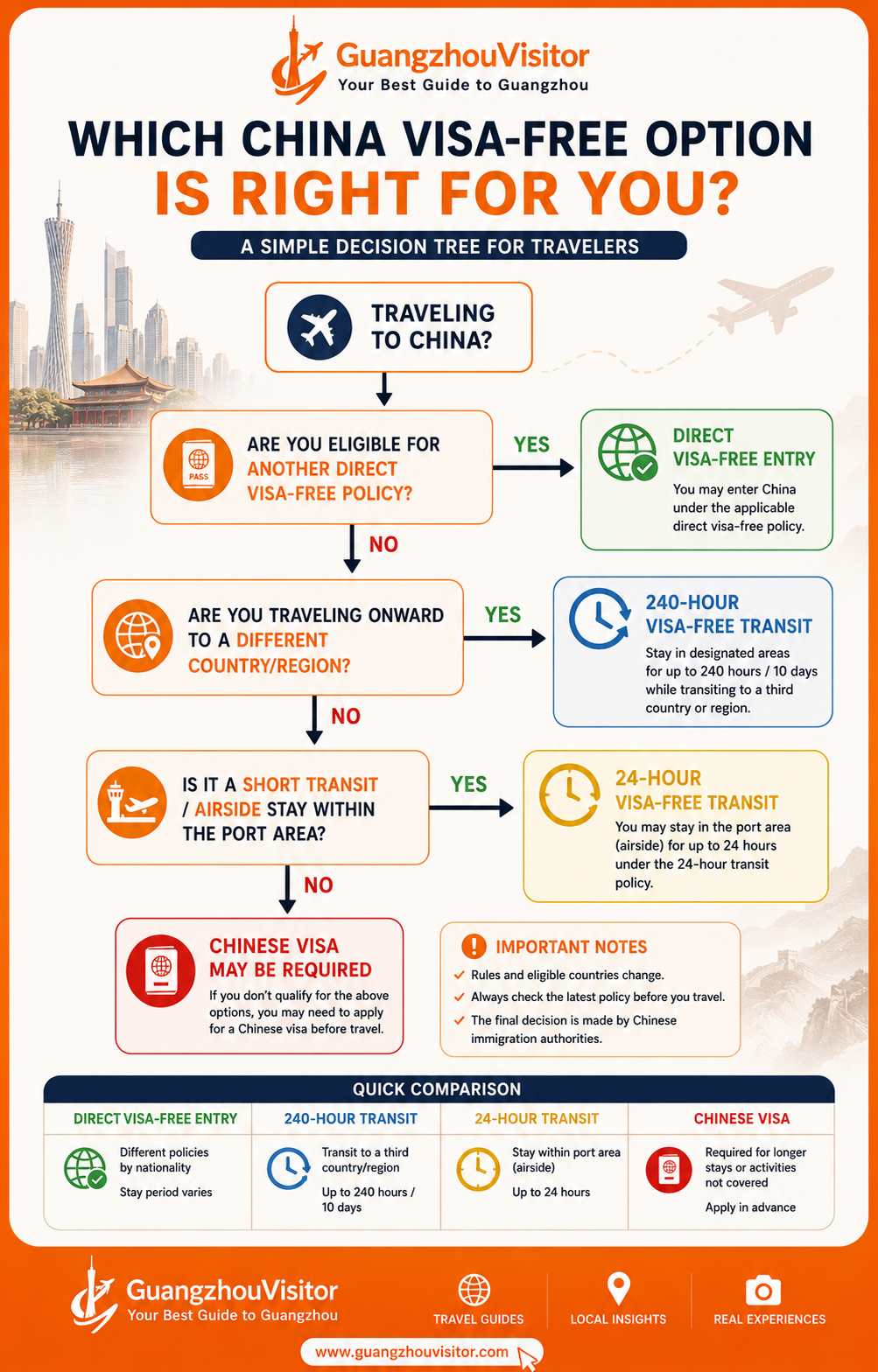
China now has several different visa-free mechanisms, and they should not be confused.
| Policy | Maximum Stay | Main Idea |
|---|---|---|
| 24-hour visa-free transit | 24 hours | Transit through China without leaving the restricted port area, subject to the rules |
| 240-hour visa-free transit | Up to 10 days | Transit through China to a third country/region |
| Other unilateral visa-free policies | Depends on nationality/policy | Direct visa-free entry under separate rules |
| Hainan visa-free entry | Up to 30 days for eligible nationalities | Separate Hainan policy |
The 240-hour system is specifically based on transiting through China to a third country or region. China also has a separate 24-hour transit policy available at open ports under its own conditions.
Don’t qualify for any visa-free option, or need to stay longer? See our China Tourist Visa (L-Visa) Guide for the standard application route, or check our China Visa-Free Entry 2026 guide for the other unilateral visa-free options.
20Example Itineraries That May Work
Here are some examples of the type of routing the policy is designed for.
Example 1 — Europe to Asia
Potentially eligible if the traveler is a French passport holder and all other requirements are satisfied.
Example 2 — Australia to China to Korea
Potentially eligible for an Australian passport holder.
Example 3 — Singapore to Guangzhou to Japan
Potentially eligible for a Singapore passport holder.
Example 4 — United States to Guangzhou to Singapore
Potentially eligible for a U.S. passport holder.
These examples illustrate the transit structure. They are not guarantees of eligibility, because the actual tickets, passport, entry port, permitted area and immigration requirements must all satisfy the current rules.

21A Practical 240-Hour Guangzhou Itinerary
If your main goal is to use the policy to visit Guangzhou, a 5–8 day stay can make much more sense than trying to squeeze everything into a short stopover.
- Immigration
- Hotel check-in
- Easy evening around the city
- Pearl River area
- Chen Clan Ancestral Hall
- Liwan
- Traditional neighborhoods
- Local food
- Canton Tower
- Zhujiang New Town
- Huacheng Square
- Pearl River evening cruise
- Wholesale markets
- Beijing Road
- Local shopping districts
- Supplier meetings
- Market research
- Pazhou area
- Canton Fair Complex if relevant
- Additional sightseeing, shopping or business meetings
- Keep your final day flexible and avoid scheduling your international departure too close to the end of your permitted stay
- Possible for travelers who want a longer stay, provided their itinerary remains within the permitted conditions and they leave before the authorized period expires
Planning meetings while you’re in town? See our guide to business hotels near Pazhou.
22Can You Use Guangzhou as a Gateway to the Canton Fair?
Potentially, yes. The 240-hour transit policy can be particularly interesting for international business visitors attending events in Guangzhou, including the Canton Fair.
Eligible travelers may use the permitted visa-free stay for short-term business activities, subject to the rules of the policy.
23What About Hong Kong and Macau?
Hong Kong and Macau have separate immigration systems from mainland China. Do not assume that entering Hong Kong or Macau automatically counts as entering mainland China under the same visa rules.
Similarly, traveling Mainland China → Hong Kong → Mainland China can create a different immigration situation from a straightforward third-country transit itinerary.
If your trip involves Hong Kong or Macau, verify the complete routing before booking non-refundable flights. This is especially important for travelers using the 240-hour policy.
24Should You Carry Printed Documents?
Yes. Even though most airline and travel information is digital, it is sensible to carry printed copies of:
- Passport information
- Onward flight confirmation
- Complete itinerary
- Hotel reservation
- Travel insurance details
- Important contact information
You should also save offline copies on your phone. This is particularly useful if your phone battery dies or you have difficulty accessing mobile data after arrival.
A few more things worth sorting before you fly:
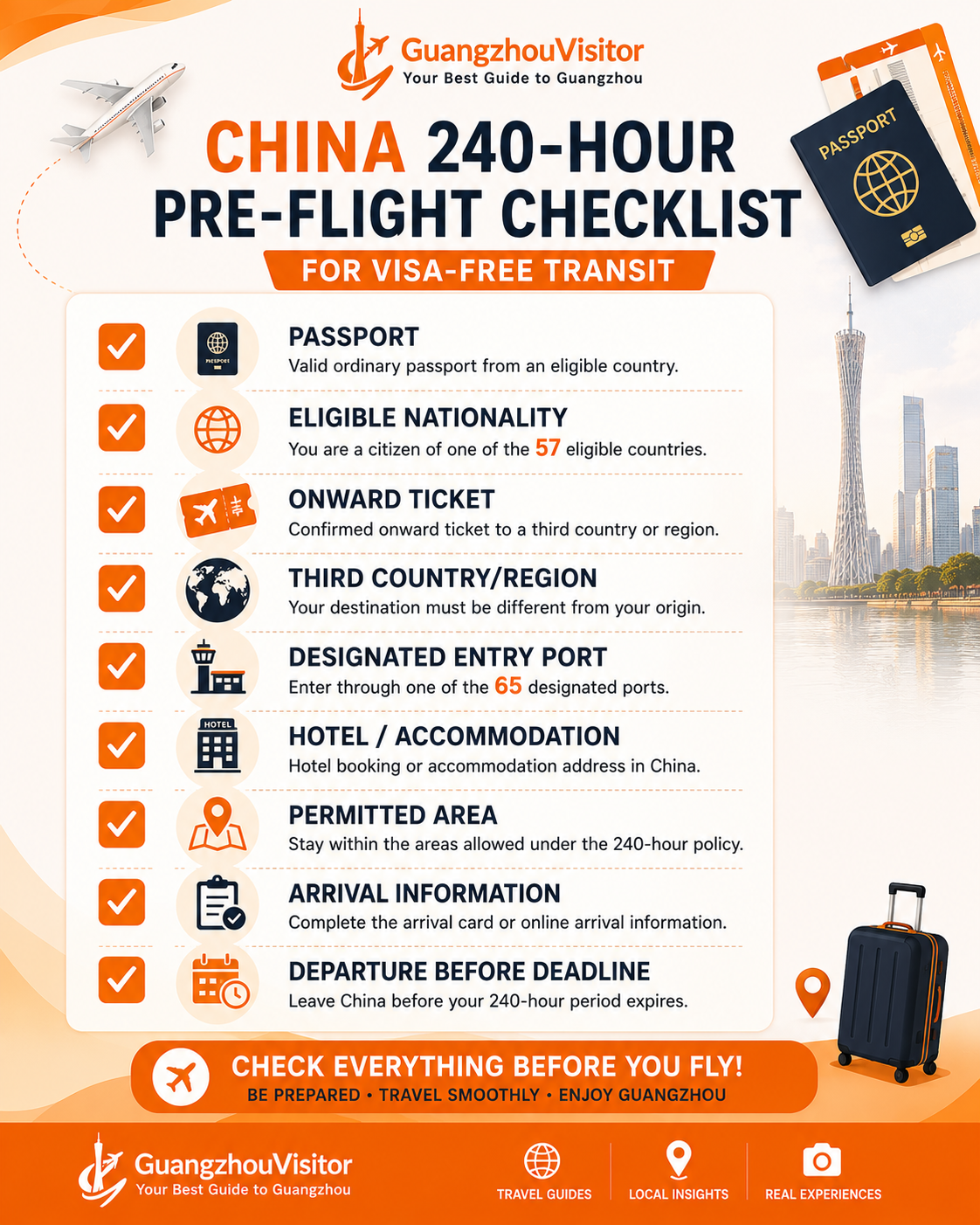
25Final Pre-Flight Checklist
Before leaving for China, check every item below.
- My nationality is one of the 57 eligible countries.
- I have an ordinary passport.
- My passport satisfies the required validity conditions.
- My itinerary travels onward to a different third country or region.
- My onward ticket has a confirmed date and itinerary.
- My entry port is one of the designated 65 ports.
- I know which areas I am permitted to visit.
- My hotel/accommodation information is available.
- I have completed or prepared the required arrival information.
- I have offline copies of my travel documents.
- My onward flight leaves before my permitted stay expires.
- I am not planning to work or study under the transit exemption.
?Frequently Asked Questions
Can I visit China for 10 days without a visa?
Is 240 hours exactly 10 days?
Can I enter through Guangzhou?
Can I visit Guangzhou for tourism?
Can I travel around China?
Can I work in China?
Can I study in China?
Do I need to apply at a Chinese embassy?
Can I use a return ticket to my home country?
Can I enter China from Hong Kong?
Can I use the policy for business?
What happens if I overstay?
✓Final Takeaway
China’s 240-hour visa-free transit policy has become one of the most useful ways for eligible international travelers to add a China trip to a broader Asian or international itinerary.
As of August 20, 2026, the program covers 57 countries and 65 designated entry ports across 24 provincial-level regions.
For travelers visiting southern China, Guangzhou is particularly interesting because Guangzhou Baiyun International Airport is part of the designated system, while Guangdong has several additional entry ports.
But the key is understanding that this is a transit exemption, not unrestricted visa-free travel.
If all of those conditions are satisfied, a 10-day China stopover can become a realistic part of your international itinerary without the need to obtain a traditional Chinese visa in advance.